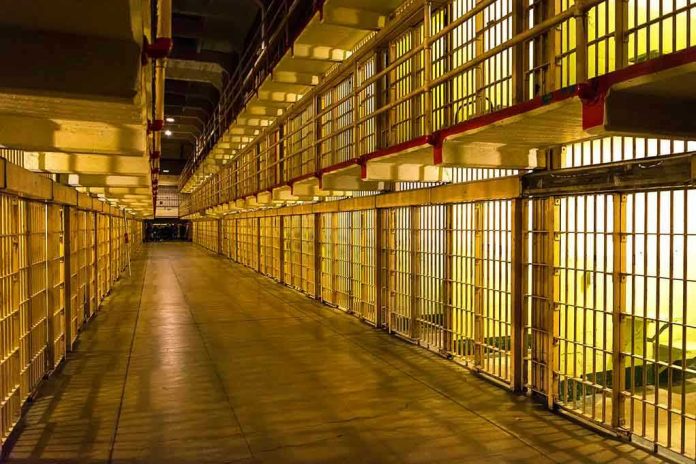
Alcatraz is back in Washington’s budget books, and the price tag signals this isn’t just nostalgia—it’s a test of how serious the country is about locking up the worst offenders.
Quick Take
- The White House budget proposal for fiscal year 2027 requests $152 million to start rebuilding Alcatraz into a modern high-security prison.
- The idea follows President Trump’s earlier directive to reopen and expand Alcatraz for “ruthless and violent” offenders.
- Alcatraz closed decades ago after operating costs ran far higher than other federal prisons, a problem any reboot must solve.
- The island currently operates as a National Park Service tourist site, so any conversion would trigger legal, logistical, and political fights.
A budget line item that reopens an old argument about punishment
The fiscal year 2027 draft budget revived Alcatraz with a concrete down payment: $152 million to begin rebuilding the former federal penitentiary into what the administration describes as a state-of-the-art secure prison. The proposal follows President Donald Trump’s earlier social media directive ordering federal agencies to plan for a substantially enlarged, rebuilt Alcatraz aimed at America’s most violent offenders. Congress still holds the real power, and that’s where the suspense lives.
https://www.youtube.com/post/UgkxQk-kOl-W4YNDSfQ8b2l3SoJmhnY82Ua7
That suspense matters because this is more than a construction story. Alcatraz is a cultural shorthand for consequences—cold water, hard walls, no romance. Bringing it back attempts to turn that symbolism into policy, using a location the public already understands. Supporters will read it as a deterrence message; critics will call it an expensive stunt. The budget request forces a simple question: is the federal system prepared to pay for “no excuses” incarceration again?
The Rock’s history makes the reboot look easy—until you price it
Alcatraz operated as a federal penitentiary from 1934 to 1963, built to hold inmates who caused trouble elsewhere and to make escape extraordinarily difficult. The island location, frigid San Francisco Bay waters, and strong currents did much of the security work. Yet the facility ultimately shut down and fully closed later, with costs cited as a decisive factor. Reports describe its operating expenses running about three times higher than other prisons—an institutional memory that haunts every reopening pitch.
Those costs weren’t a footnote; they were the point. Everything on an island costs more: staff transport, food, fuel, maintenance, emergency response, and construction logistics that don’t exist on the mainland. A modern rebuild must also satisfy today’s expectations—surveillance systems, hardened perimeters, medical capacity, communications infrastructure, and compliance standards that didn’t exist in the 1960s. If total rebuilding estimates land in the billions, the public will demand proof that the “state-of-the-art” claim reduces long-term operating costs instead of repeating history.
Tourist landmark vs. high-security prison: the coming jurisdiction fight
Alcatraz is no longer simply a building; it’s an economy. The National Park Service operates the site as a major tourist attraction, and that reality collides head-on with any plan to return it to the Bureau of Prisons. The fight wouldn’t just be political theater. A transfer would raise operational questions about access, safety zones, ferry logistics, and what happens to an active prison sitting in the middle of one of America’s most photographed destinations.
That tension will shape congressional behavior, because lawmakers don’t appropriate money in a vacuum. A high-profile, high-cost conversion invites competing constituencies to line up: public safety advocates, budget hawks, local business interests tied to tourism, and residents who don’t want a new magnet for security incidents in the Bay. A critic such as former House Speaker Nancy Pelosi calling it Trump’s “stupidest initiative yet” adds a partisan accelerant, but the practical objections don’t require partisanship to be real.
What conservatives should demand before paying a dime
Conservative common sense starts with clarity: define the mission, then judge the tool. If the goal is to incapacitate the most dangerous federal offenders, the plan must show why an island rebuild beats expanding existing high-security capacity or upgrading current facilities. If the goal is deterrence, lawmakers should ask whether symbolism justifies billions in capital costs and ongoing island premiums. Tough-on-crime policy works best when it is boringly effective: measurable safety outcomes, controlled spending, and minimal bureaucratic drift.
The strongest version of this proposal treats Alcatraz like a specialized instrument, not a museum piece turned into a campaign prop. That means strict criteria for who goes there, a clear operational model, and hard commitments on cost containment—especially given the facility’s history of being far more expensive than alternatives. Congress should also demand transparency on the “first-year” scope: what exactly does $152 million buy, what deadlines attach, and what legal steps must happen before a single contractor steps onto the island?
Alcatraz’s return remains only a proposal, and that’s the point: it forces a national argument about priorities before the nation commits to pouring concrete. If Congress approves the opening spend, the second act begins fast—agency plans, environmental and jurisdictional hurdles, and a running battle over whether the island’s fame helps public safety or distracts from it. The Rock may be surrounded by water, but the real test sits on dry land: can Washington build a prison that’s tough, modern, and fiscally sane?
Sources:
Trump requested 152 million to rebuild Alcatraz prison closed in 1969
Trump seeks 152 million to reopen Alcatraz as active prison