

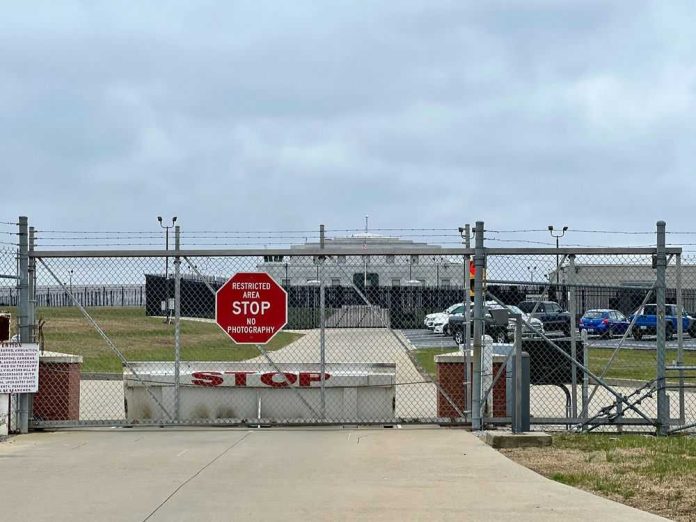
A trespasser breached Denver International Airport’s perimeter security, scaled a fence, and sprinted onto an active runway where a Frontier Airlines jet traveling at takeoff speed struck and killed them in seconds, forcing 231 passengers and crew to evacuate amid an engine fire and raising hard questions about how someone can reach a runway undetected at one of America’s busiest airports.
Quick Take
- Frontier Airlines Flight 4345 struck a trespasser on Runway 17L at approximately 11:19 p.m. on Friday, May 8, 2026, killing the individual and triggering an engine fire that pilots immediately reported to air traffic control [1]
- Transportation Secretary Sean Duffy confirmed the person jumped the perimeter fence and reached the runway in roughly two minutes, with Denver International Airport stating the fence remained intact post-breach [1][4]
- Emergency response prevented major injuries among 224 passengers and seven crew members, with 12 reporting minor injuries and five transported to hospitals [1][8]
- The National Transportation Safety Board (NTSB) was notified and Runway 17L closed for investigation, with authorities coordinating across local law enforcement, Federal Aviation Administration (FAA), and Transportation Security Administration (TSA) [4][8]
The Breach Happened in Plain Sight
The timeline exposes a critical vulnerability. According to airport officials, the unidentified trespasser jumped the perimeter fence and was struck by the aircraft just two minutes later while crossing Runway 17L [1][8]. During those 120 seconds, the individual traversed an active runway where a fully loaded commercial jet was accelerating for takeoff. The pilot told air traffic control, “We just hit somebody. We have an engine fire,” capturing the moment of collision with clinical precision [1]. What remains unanswered is how motion sensors, security cameras, or ground personnel monitoring an active runway failed to detect movement during those critical two minutes.
The Immediate Response Worked
Once the collision occurred, the system functioned as designed. The pilot immediately aborted takeoff procedures. Air traffic control dispatched emergency vehicles. Denver Fire Department extinguished the engine fire promptly. Passengers evacuated via slides to the tarmac and were bussed to the terminal [4][8]. The outcome could have been catastrophic—231 people on board, smoke in the cabin, an active fire. Instead, coordinated emergency protocols prevented fatalities among passengers and crew, with only minor injuries reported. Frontier Airlines and the airport coordinated evacuation procedures efficiently, demonstrating that once a threat is identified, response protocols work [1][4].
Questions About Perimeter Security Remain Unresolved
Denver International Airport stated the perimeter fence was intact following the breach, supporting the narrative that this was an unforeseeable criminal act rather than a systemic security failure [1][8]. However, the airport has not released specific details about perimeter monitoring systems active at the time—camera locations, motion sensor coverage, patrol schedules, or response times to alerts. The fact that someone could jump a fence and reach an active runway in 120 seconds without triggering detectable alarms raises legitimate questions about whether monitoring systems were functioning, properly positioned, or adequately staffed [1][4].
The Trespasser’s Identity and Motivation Remain Unknown
Airport officials stated the individual is not believed to be an airport employee, but the person has not been publicly identified, and no details on motivation, mental state, or prior history have been disclosed [8]. Law enforcement has not released findings from the autopsy or toxicology reports. Without this information, it is impossible to determine whether this represents a random breach or whether the person had insider knowledge of security gaps, prior familiarity with the airport, or was experiencing a mental health crisis [1][4]. These details matter for assessing whether this was truly unforeseeable or symptomatic of a deeper vulnerability.
How does someone jump a perimeter fence at a major U.S. airport and reach an active runway in under two minutes?
Last night at Denver International, a Frontier Airlines plane taking off for LA struck and killed a pedestrian on the runway. Engine caught fire. Plane evacuated.… pic.twitter.com/U4HhmDGebC— jackwindsor (@jackwindsor) May 9, 2026
What Happens Next
The National Transportation Safety Board (NTSB) investigation will examine the incident, though preliminary findings have not yet been released [4][8]. Runway 17L remained closed pending investigation completion. Local law enforcement, the FAA, and TSA are coordinating the probe. The aviation community will scrutinize whether this incident reflects an isolated breach or part of a broader pattern of runway security lapses. Until the NTSB releases its preliminary report and authorities disclose security monitoring data, forensic analysis of the fence, and details on the trespasser’s identity and method, the full picture of what failed—and whether it was preventable—will remain incomplete [1][4].