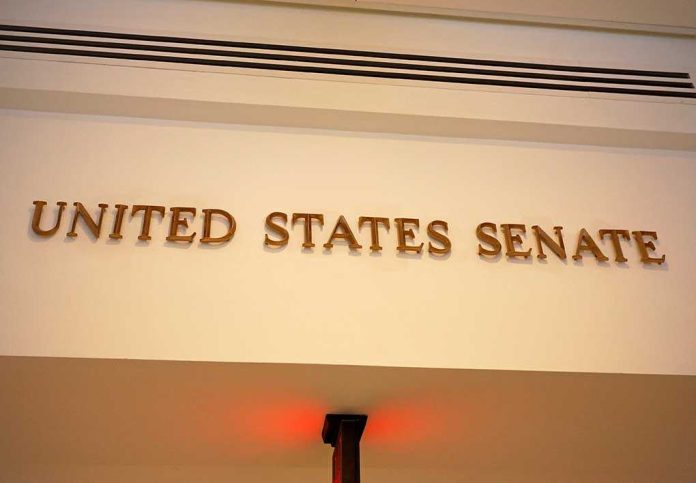
A $70 billion Senate immigration package just put immigration and border enforcement squarely on President Trump’s tab for the rest of his term—and left Democrats fuming that they could not shackle it with their usual strings.
Story Snapshot
- The Senate approved roughly $70 billion to fund Immigration and Customs Enforcement and Border Patrol through the end of President Trump’s term.[2]
- The bill is framed as a concrete enforcement package, not a symbolic gesture, with multi‑year funding for front‑line operations.[1][2]
- Democrats attacked the bill for omitting new limits on immigration agents and preserving a Trump‑linked “anti‑weaponization” settlement fund.[1]
- Supporters call it a long‑overdue step to restore law and order at the border, while critics offer no hard evidence the funds will fail.[1][2]
Senate Backs Multi‑Year Funding For Real Immigration Enforcement
Senate Republicans pushed through a roughly $70 billion immigration enforcement package that finances Immigration and Customs Enforcement and Border Patrol through the rest of President Trump’s term, giving the White House a clear legislative win on border security.[2] Reporting describes the measure as funding Trump’s immigration enforcement agencies through approximately 2029, locking in resources beyond a single budget fight and signaling that Congress intends these front‑line operations to have stable support rather than stop‑and‑start appropriations.[1][2]
Coverage notes that the legislation is not a symbolic resolution but an operational funding package, allocating money directly to enforcement agencies instead of issuing vague policy statements.[1][2] Republicans have framed the bill as an effort to strengthen the border and interior enforcement apparatus over time by committing multi‑year resources to hiring, operations, and equipment.[1] That structure allows defenders to argue they are addressing capacity, not just issuing talking points or passing a one‑year patch that leaves agencies guessing about next year’s budget.[1][2]
Narrow Vote, Clear Message: Voters Asked For Enforcement, Not Open Borders
The measure cleared the Senate by a 52–47 margin, a narrow but real majority that gives the Trump administration and Republican sponsors a democratically endorsed enforcement policy to point to when critics claim Congress will not act on the border crisis.[2] Supporters highlight that the package funds Immigration and Customs Enforcement and Border Patrol operations through the end of this presidential term and into the next three years, suggesting a sustained commitment rather than a one‑off political gesture.[1][2]
Republican messaging centers on the claim that fully funding these agencies will make the country safer by backing up agents who have faced years of resource shortages, legal obstacles, and mixed signals from Washington.[1] At the same time, the available record does not yet include detailed appropriations tables, making it difficult for outside observers to track exactly how much will go to personnel, detention space, transport, technology, or other line items.[1][2] That gap leaves room for future oversight to determine how effectively the money is converted into more removals and fewer unlawful crossings.[1][2]
Democrats Rage Over Trump‑Linked Fund But Offer Thin Policy Rebuttal
Democratic leaders opposed the bill in part because it does not impose new limits on President Trump’s multibillion‑dollar settlement or “anti‑weaponization” fund, a long‑running point of contention they describe as a political “slush fund.” Reporting indicates that preserving this fund without added guardrails triggered weeks of delays and fierce objections, with critics insisting the enforcement money should be conditioned on restricting how the Trump administration can deploy those resources.[1]
The Senate passed a roughly $70 billion reconciliation bill in a 52–47 vote to fund Immigration and Customs Enforcement and the Border Patrol through the end of Trump’s term…the bill will now head to the House for a vote
— Simple American News 🗞️ (@TSimpleAmerican) June 5, 2026
Opponents such as Senate Minority Leader Chuck Schumer focused on the decision to approve enforcement funding while declining to outlaw or tightly constrain the Trump‑linked fund, casting the package as a partisan giveaway rather than a neutral security measure. However, the dissent on record concentrates heavily on that political funding dispute rather than offering empirical evidence that the new money for Immigration and Customs Enforcement and Border Patrol will fail to improve control of the border or interior removals.[1] The criticism remains largely rhetorical, not rooted in agency performance data or detailed budget forensics.[1]
Big Money, Bigger Questions: Will Washington Finally Enforce The Law?
Nonpartisan context from immigration policy analysts notes that this episode fits a familiar pattern in United States immigration debates, where large enforcement appropriations are defended as essential operational funding and attacked as expensive political theater.[2] The Senate’s action is clearly a funding vote, not proof on its own that unlawful migration will fall or that removals will rise, because appropriations establish resources but do not guarantee that agencies can hire quickly, expand detention capacity, or navigate legal constraints efficiently.[2]
The present public record does not yet include formal evaluations from watchdogs such as the Government Accountability Office or the Department of Homeland Security Inspector General on whether Immigration and Customs Enforcement and Border Patrol can absorb this surge of funding without waste or bottlenecks.[1][2] That means conservatives who demanded serious enforcement can rightly view the bill as an important step, while still insisting on aggressive oversight to ensure the money produces measurable gains in border security rather than being swallowed by bureaucracy, red tape, or future political interference.[1][2]
Sources:
[2] YouTube – Senate Republicans pass $70B bill funding ICE, Border Patrol