

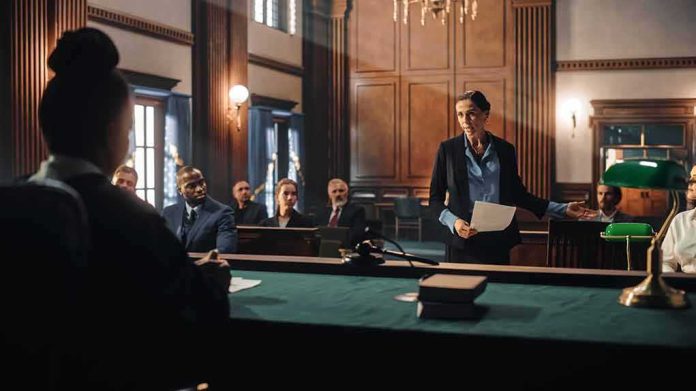
As jurors enter a third day of deliberations in the Lindsay Clancy trial, the judge’s clear rules now define what justice must look like in this case.
Story Snapshot
- Jurors began a third day of deliberations Monday after detailed legal instructions from the judge.
- Judge William Sullivan told jurors the Commonwealth must prove guilt beyond a reasonable doubt.
- The judge said Clancy’s choice not to testify cannot be used against her.
- Instructions track Massachusetts model rules on criminal responsibility and proof standards.
Jury Deliberations Enter Day Three Under Firm Court Rules
Jurors in the Lindsay Clancy murder trial returned Monday for a third day of deliberations after receiving final instructions on the law from Judge William Sullivan. Sullivan reminded jurors that they must decide the case only on the evidence and the law, not on media or outside talk. He told them the Commonwealth carries the full burden to prove guilt beyond a reasonable doubt, and that the defense has no obligation to present proof.
Sullivan also told jurors they cannot hold it against Clancy that she chose not to testify, and they must not draw any inference from indictments or charges alone. These are guardrails that courts use to keep trials fair. They force the government to meet a high standard and protect the presumption of innocence. Such instructions are common in serious cases, and they shape how the jury weighs evidence when emotions run high.
What The Law Requires Jurors To Decide
Massachusetts model instructions say prosecutors must prove, beyond a reasonable doubt, both that the defendant committed the acts charged and that she was criminally responsible when they happened. Judge Sullivan told the parties he would rely on the state’s model framework for criminal responsibility in shaping his charge to the jury. That framework puts the burden squarely on the Commonwealth and does not shift it to the defendant at any point.
Pattern instructions also define “proof beyond a reasonable doubt” as a strong, lasting belief that the charge is true, not a guess or suspicion. By anchoring the jury to this standard, the court narrows the path to a conviction to evidence that leaves jurors with an abiding conviction, not just concern or outrage. This design is part of why criminal trials move carefully and why deliberations can take days.
Why These Safeguards Matter In A High-Profile Case
High-profile trials create noise that can sway public opinion. The court’s instructions are meant to filter that out. Sullivan repeatedly warned jurors to avoid outside information and decide only on what they heard in court. He also struck testimony that touched on religion as irrelevant to guilt or innocence, signaling that personal beliefs are not on trial and should not color the verdict. These limits aim to keep the focus on facts and law, not identity or headlines.
"In the Lindsay Clancy Murder Trial, Judge William Sullivan gave the first half of the jury instructions, the prosecution and defense delivered closing arguments, and the judge is delivering the final batch of instructions before sending the jury to deliberate."
— Brent Cutburth (@brentcutburth) August 27, 2026
For readers across the political spectrum, these steps speak to a basic promise: the state must prove its case, every time, even when pressure builds. Many Americans doubt that powerful systems play fair. Here, the process forces accountability. The prosecution must meet the highest burden our courts know. The defense does not need to prove anything. The jury must block out noise. These rules are not special favors. They are the foundation of due process.
Sources:
bostonherald.com, cbsnews.com, youtube.com, patriotledger.com, nypost.com, bostonglobe.com, mass.gov