

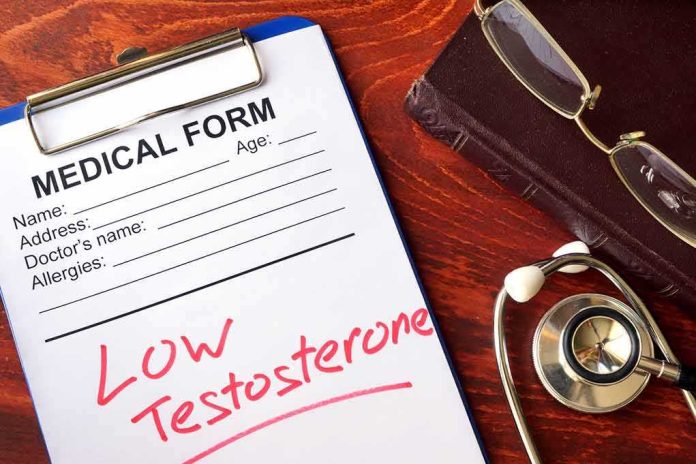
The Pentagon just made testosterone checks mandatory for every service member 30 and older, and the fallout could reshape military medicine.
Story Snapshot
- The order makes annual testosterone screening part of the Periodic Health Assessment for ages 30+.
- Defense leaders frame it as a readiness and performance initiative.
- Top medical groups advise against routine population screening in asymptomatic men.
- Doctors warn about false positives, costs, and risks from overtreatment.
What the new policy actually orders
The Defense Department issued a formal memorandum on July 15, 2026, directing all Active Duty and Reserve Component personnel aged 30 and older to be screened for testosterone deficiency during their annual Periodic Health Assessment. The document ties the change to force health and performance goals and makes the screening a mandatory element of that assessment. Public briefings and reports confirmed the requirement and its link to readiness messaging from senior leadership.
The order does not compel treatment. Leaders say the aim is to identify possible deficiency and guide troops to discuss options with clinicians. Coverage across major outlets emphasized that service members can choose whether to pursue therapy if results suggest deficiency. That distinction matters. Screening is not the same as prescribing hormones. But screening at scale creates downstream decisions, workloads, and second-order effects that units will feel.
Why broad screening collides with medical guidance
Most specialty guidelines caution against routine testosterone screening in men without symptoms. The Endocrine Society’s clinical guidance recommends making the diagnosis only when symptoms and low levels align, and it advises against population-level screening in asymptomatic men. Reuters reported that four of six physicians saw no solid evidence that universal screening improves combat readiness and five of six worried about unnecessary or harmful treatment. That skepticism reflects years of data on testing pitfalls and ambiguous “low-normal” results.
Doctors also flag testing traps. Testosterone levels swing with time of day, sleep, weight, illness, and lab variance. A low reading often needs repeat, morning, fasting confirmation to be valid. Without careful protocols, false positives pile up and trigger follow-up tests, imaging, referrals, and anxiety for troops and families. CBS News highlighted concerns about costs, false positives, and no proof that mass screening makes healthy 30-year-olds perform better. Conservative stewardship says measure twice, cut once.
Readiness math: potential gains and hidden risks
Proponents argue the force faces heavy stress loads, disrupted sleep, and grueling training cycles that can reduce testosterone, and that finding true deficiency could improve energy, bone health, and recovery. That case resonates with common sense and a warrior culture. But population screening changes base rates. When you test everyone, you mostly find borderline or incidental lows, not clear disease. That can swell clinic lines without clear gains in unit performance. Evidence for broad readiness benefits remains thin compared with targeted testing.
Therapy itself has trade-offs. Testosterone can lower sperm counts, shrink testicular size, and complicate prostate monitoring, which matters for younger troops starting families and for long careers. None of this rules out therapy for men who truly need it. It argues for discipline: confirm the diagnosis, treat symptoms and causes, and prioritize lifestyle fixes like sleep, weight loss, resistance training, and alcohol control. That is the conservative path: fix root problems first, medicate when the case is strong.
How commanders and clinicians can make this work
Command teams should build simple guardrails now. Schedule blood draws in the morning with fasting instructions. Require repeat confirmation before labeling a case. Pair any low reading with a symptom checklist and a targeted exam. Train providers to screen for thyroid disease, sleep apnea, depression, diabetes, pain meds, and heavy drinking that can mimic low testosterone. Reserve prescriptions for men with consistent low levels and clear symptoms after lifestyle steps fail. This keeps readiness high and waste low.
Leaders should also remove career pressure. Make it explicit that testosterone numbers will not affect evaluations, promotions, deployments, or special duty eligibility. Publish that policy in writing. Use dashboards to track false positive rates, referrals, therapy starts, fertility counseling, and adverse events. Commit to a one-year review with public metrics. If the data show benefit, keep going. If not, pivot to a targeted approach. That is accountable government in uniform.
Bottom line for the force
The new screening mandate is real, immediate, and framed as a readiness play. The medical case for testing everyone over 30 is not settled, and many experts advise a tighter, symptom-led approach. The wise course is to implement with rigor, protect troops from coercion, and hold the policy to measurable results. Readiness loves discipline. That should apply to medicine as much as to marksmanship.
Sources:
cbsnews.com, bbc.com, abc11.com, pbs.org, media.defense.gov, legion.org, politico.com