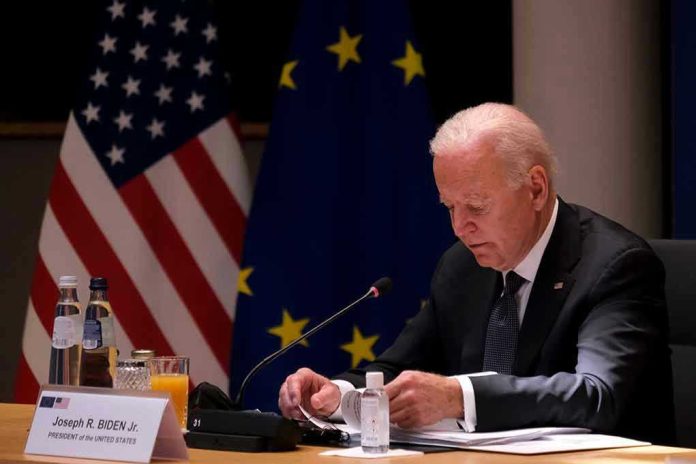
Seventy hours of audio recordings exist in which Joe Biden discussed classified materials with an uncleared ghostwriter, and now Biden is fighting in court to make sure you never hear a single second of them.
Story Snapshot
- Biden intends to intervene in litigation to block the Trump administration from releasing 70 hours of partially recorded conversations between him and ghostwriter Mark Zwonitzer.
- Special Counsel Robert Hur’s February 2024 report confirmed the recordings had “significant evidentiary value,” capturing Biden discussing classified Afghanistan materials with someone who held no security clearance.
- Zwonitzer deleted audio recordings in the weeks immediately following Hur’s January 2023 appointment, though Hur declined to prosecute, citing insufficient evidence of criminal intent.
- House Judiciary Committee Chairman Jim Jordan subpoenaed Zwonitzer in March 2024 after he failed to voluntarily produce recordings and transcripts referenced in the Hur report.
Biden Read Classified Secrets Aloud to Someone With No Clearance
The core facts are not in serious dispute. Special Counsel Robert Hur’s February 2024 report documented that Biden read classified information from his notebooks “nearly verbatim, sometimes for an hour or more at a time” to Zwonitzer on at least three separate occasions. [5] The notebooks contained sensitive information related to the Afghanistan troop surge and military decision-making from Biden’s time as Vice President. Zwonitzer held no security clearance. None of this is alleged. Hur put it in writing.
Biden’s legal argument rests on the idea that these recordings serve no legitimate public interest and that their release is politically motivated. That position is difficult to sustain when the government’s own special counsel described the audio as having “significant evidentiary value.” [5] Claiming no public interest exists in recordings of a former president reading classified national security materials aloud to a private citizen is not a legal argument. It is a preference dressed up as one.
The Ghostwriter Deleted Evidence After the Investigation Began
Zwonitzer deleted audio recordings in the weeks following Hur’s appointment in January 2023. Hur testified that Zwonitzer “slid those files into his recycle bin on his computer” after learning of the investigation. [1] Zwonitzer told investigators he deleted the files due to concerns about hacking and because he did not believe they contained classified information. Hur ultimately accepted that explanation as plausible and declined to prosecute, noting that Zwonitzer had preserved transcripts containing some of the most incriminating statements. [5]
The preserved transcripts include Biden’s 2017 statement about finding “all the classified stuff downstairs,” a remark that became central to the entire investigation. [5] Hur’s declination to prosecute Zwonitzer was not an exoneration of the conduct. It was a prosecutorial judgment call about provable intent. The timing of those deletions, coming immediately after the special counsel’s appointment was publicly known, remains a fact that no innocent explanation fully neutralizes.
Congress Subpoenaed the Ghostwriter and Got Stonewalled
House Judiciary Committee Chairman Jim Jordan issued a formal subpoena to Zwonitzer on March 22, 2024, after Zwonitzer failed to voluntarily provide the committee with documents, transcripts, and audio recordings referenced in Hur’s report. [4] The subpoena came after Hur’s own report had already been made public, meaning Congress was not fishing for evidence. They were asking for materials whose existence had already been officially confirmed. Non-compliance with that request is a meaningful data point about how willing the principals in this story are to face scrutiny.
Biden Moves to Block Release of 70 Hours of Audio Recordings With Ghostwriter https://t.co/p6uykSoiyY
— Rachel Morse (@rm36863307) May 10, 2026
Biden previously invoked executive privilege in May 2024 to block the audio recording of his own Hur interview from reaching Congress. [6] That privilege claim was enforced by then-Attorney General Merrick Garland. Now, with a new administration in place, the Department of Justice is moving in the opposite direction, and Biden is scrambling to intervene legally before the audio goes public. The pattern here is consistent: maximum resistance to disclosure at every stage, from the ghostwriter’s deleted files to Biden’s own privilege claims.
What 70 Hours of Audio Could Actually Reveal
The 70 hours of recordings were obtained by investigators working with Hur’s team during the classified documents probe. [5] Hur’s report described Biden reading from notebooks containing sensitive Afghanistan surge materials, Situation Room discussions, and military planning details. The recordings captured those sessions in real time. Whatever Biden said in those conversations, he said to a man with no security clearance, and investigators believed the audio was significant enough to obtain and preserve. The public has not heard any of it. Biden intends to keep things that way.
The argument that releasing these recordings constitutes political retaliation is worth examining on its merits. Partisan motivation and legitimate public interest are not mutually exclusive. The Nixon tapes were politically devastating and historically essential. The question is not why the Trump administration wants the audio released. The question is what is on 70 hours of tape that a former president is willing to go to court to suppress. That question answers itself.
Sources:
[1] Hur confirms Biden’s ghostwriter destroyed evidence after special …
[4] Chairman Jordan Subpoenas President Biden’s Ghostwriter
[5] [PDF] report-from-special-counsel-robert-k-hur-february-2024.pdf
[6] Joe Biden classified documents incident – Wikipedia