Canada will not suddenly fall off an economic cliff in 2026—but one bad decision on trade could lock in a slow, grinding decline that feels a lot like collapse for ordinary Canadians.
Story Snapshot
- Canada’s real threat is not instant collapse, but a long stagnation that quietly erodes living standards.
- The 2026 CUSMA/USMCA review is the single biggest external risk hanging over Canada’s economy.
- A fragile mix of housing debt, poor productivity, and affordability stress could amplify any trade shock.
- Conservative, pro‑market reforms could turn this “collapse” narrative into a wake‑up call instead of a prophecy.
The collapse narrative and what would actually have to happen
Commentators shouting “Canada will COLLAPSE if this happens” tap into a real anxiety: the sense that the country’s economic engine has shifted from humming to sputtering. Forecasts from mainstream institutions do not show a crater; they show weak but positive growth around 1–2.2% in 2026, the textbook definition of an economy drifting rather than crashing. That gap between rhetoric and reality is where the real story—and the real risk—sits for anyone who cares about long‑term prosperity.
The key word is “cluster.” No single lever guarantees collapse, but a bad outcome in the 2026 CUSMA review layered on top of an affordability crisis, record household debt, and chronic productivity weakness could make Canada feel stuck for a decade. From a conservative, common‑sense standpoint, that looks less like a natural disaster and more like the compound result of policy complacency: too much faith in cheap money, too little urgency on competitiveness, and an assumption that U.S. access is permanent.
How the 2026 CUSMA review became Canada’s economic do‑or‑die test
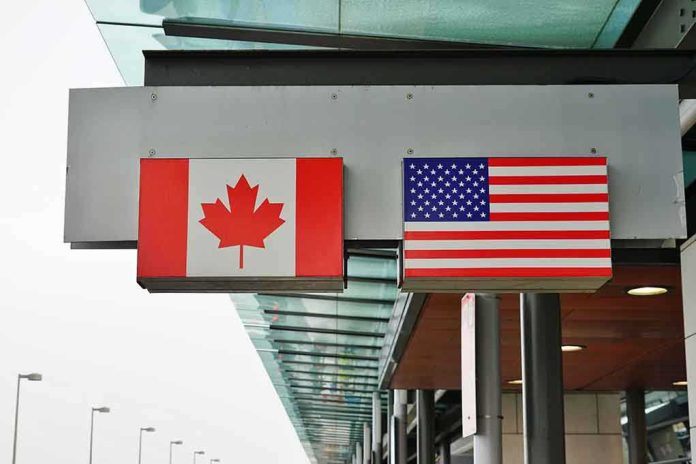
The Canada‑United States‑Mexico Agreement, which replaced NAFTA, built a timer right into the trade relationship: a formal review in 2026 that can either renew stability or reopen old wounds. Canada sends roughly three‑quarters of its exports to the U.S., a degree of dependence few advanced economies tolerate. The Bank of Canada’s governing council has already labelled that 2026 review a “significant risk” and discussed worst‑case scenarios involving dissolution and sharply higher tariffs.
Those worst‑case scenarios matter because they land on an economy already running with little margin for error. Business development and economic outlook reports warn that the review is likely to weigh on business investment even before any decision is made, as firms delay big bets until they see whether North American trade remains predictable. If Washington pushes for tariffs or rules that disadvantage Canadian producers, the immediate hit falls on autos, manufacturing, and agriculture—but the secondary blow hits confidence, the dollar, and government revenues.
Housing, debt, and productivity: the slow‑burn accelerants
Trade risk would be dangerous in any country; in Canada’s case, it lands on top of a housing and debt structure that magnifies shocks. Years of ultra‑low interest rates, combined with constrained housing supply and high immigration, drove house‑price‑to‑income ratios and household debt to among the highest in the world. As rates rose after the pandemic, debt‑service costs jumped, squeezing middle‑class budgets even as wages struggled to keep up with inflation and taxes.
At the same time, Canada’s productivity growth has lagged behind the United States and other peers, meaning each worker produces less output per hour than competitors to the south. Lower productivity translates into lower income potential and less tax capacity to fund the generous welfare state built over previous decades. Conservative economics would argue this is the predictable consequence of high regulation, slow permitting, and tepid competition policy: when capital and projects take years to clear approvals, they go elsewhere, and living standards drift down relative to more dynamic jurisdictions.
Why the most likely future is stagnation, not sudden collapse
Economic outlooks from major banks and advisory firms converge on an unexciting but sobering baseline: Canada muddles through 2026 with modest growth, subdued investment, and persistent affordability problems. The Business Development Bank of Canada projects only 1% GDP growth in 2026, calling it “another turbulent one,” while RSM pegs growth at 2.2% but emphasizes headwinds from trade tensions, an oil glut, and an affordability crunch. None of these institutions predict state failure; all warn about structural drag.
From a values‑based lens that emphasizes responsibility and realism, the more honest fear is a Japan‑style stagnation rather than a Venezuela‑style implosion. Slow growth, high debt, and aging demographics could mean higher taxes, strained health systems, and younger Canadians locked out of ownership. That kind of slow bleed may be less dramatic than a crash, but it corrodes social trust just as effectively—and it becomes politically tempting to paper over the problem with more borrowing instead of reform.
What a conservative course‑correction would look like
Analysts who take the “collapse” language seriously but not literally tend to converge on a similar prescription: treat 2026 as a pivot point, not a cliff. That means pushing hard for a stable CUSMA outcome while using the pressure of the review to clean up Canada’s side of the ledger—faster approvals for productive investment, incentives for business R&D and capital spending, and a regulatory reset that favours competition over cozy protection. These align with traditional conservative priorities: open markets, limited but effective government, and growth driven by private enterprise.
On the domestic front, addressing the housing‑affordability tangle requires more supply and less distortion, not endless subsidies. Loosening zoning, accelerating permitting, and aligning infrastructure with growth corridors reflect common‑sense principles: let markets build, ensure rules are clear, and reserve taxpayer support for genuine need rather than inflating demand. If policymakers take that path while securing continental trade, “Canada will collapse if this happens” becomes less a forecast and more a cautionary tale about what happens when a country forgets that prosperity is earned, not guaranteed.
Sources:
RBC – Beyond the forecast: Six themes for Canada’s economy in 2026
Morningstar – Canada’s market rally enters 2026: Growth ahead, gains may be tamer
RSM – Economic outlook for 2026
Financial Post – The Canadian economy faces 3 risks in 2026
BDC – Canadian economic outlook for 2026
RBC Investor & Treasury Services – Canada economic trends 2026
Morningstar – Canadian dollar is poised to climb higher against U.S. dollar, barring trade risk