

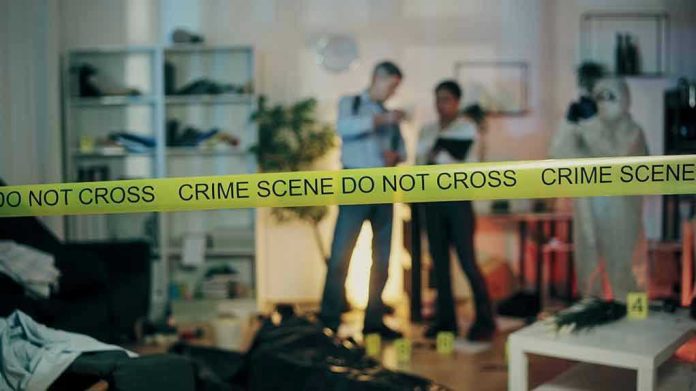
The most unsettling part of the MIT professor’s killing is not just the violence itself, but how it shatters the illusion that elite knowledge and a safe neighborhood can somehow insulate anyone from chaos.
Story Snapshot
- A 47-year-old MIT fusion scientist, Nuno F. G. Loureiro, was shot and killed at his Brookline apartment.
- Police have intensified the search for the suspect, but key questions about motive and security remain unanswered.
- The case exposes how even America’s most educated and “secure” communities now live with urban-style risk.
- The story forces a hard look at crime, policing, and what public safety really means for ordinary citizens.
A killing that broke the barrier between elite safety and everyday violence
Police in Brookline, Massachusetts, responded Monday night to the kind of call that usually belongs to a very different zip code: a shooting at a residential apartment, the victim a 47-year-old MIT professor and fusion scientist, Nuno F. G. Loureiro. Neighbors in this quiet, high-education enclave now share a detail they never expected to utter: someone murdered a world-class physicist in their building. That detail alone reorders how they think about safety, risk, and community.
This was not a late-night alleyway dispute or a street-corner drug deal gone bad. This happened in an apartment, in a town many view as an extension of MIT’s and Harvard’s intellectual orbit, where the default expectation is stability, not gunfire. When police publicly announce they are “intensifying” the search for a suspect in a place like Brookline, it signals more than a manhunt. It signals that the comfortable mental line between “their crime problem” and “our safe neighborhood” has been erased, at least for now.
Who Nuno Loureiro was, and why that matters beyond academia
Nuno F. G. Loureiro was not a celebrity in the Hollywood sense, but in the world of physics and fusion research he was a serious player. Fusion science sits at the intersection of energy security, economic growth, and technological leadership—exactly the kind of field Americans say they want to see flourish. When someone dedicates decades to such work and ends up fatally shot at home, the story becomes bigger than one tragic crime; it becomes a commentary on what we truly protect and what we leave vulnerable.
Citizens who pay attention to innovation understand that people like Loureiro are part of the long game that keeps America competitive. Conservative-minded readers who care about strong national capabilities—energy independence, scientific excellence, secure infrastructure—see an obvious contradiction: the country can pour billions into labs and grants, but if the people behind the breakthroughs are not safe in their own homes, the system leaks value where it can least afford to.
Crime, community, and the myth of “safe” neighborhoods
Brookline has long marketed itself—implicitly if not explicitly—as the antidote to big-city insecurity. Well-rated schools, well-kept streets, and proximity to elite universities feed the belief that serious crime is something that happens elsewhere. The fatal shooting of an MIT professor inside this environment forces residents to wrestle with a harder reality: crime trends, mental health breakdowns, drug crises, or targeted grievances do not always respect municipal borders or income brackets.
Common-sense conservatives often argue that every community, no matter how wealthy or educated, needs credible law enforcement, clear consequences for violent crime, and a justice system that tilts toward protecting the innocent rather than excusing the dangerous. This case strengthens that argument. When a highly accomplished academic can be killed at home and the suspect remains at large, residents do not ask for softer rhetoric; they ask whether their leaders, prosecutors, and courts still treat public safety as a first obligation, not a negotiable talking point.
Policing, policy, and the cost of hesitation
Police have publicly intensified their search for the suspect, which suggests urgency, but it also raises a quiet question: why does the system so often seem reactive instead of preventive? No article can answer that for this specific case without more facts. However, recent national patterns show a familiar loop: public officials talk about “root causes,” reduce penalties, or hesitate to fully enforce existing laws, and then act shocked when citizens experience the predictable effects of those choices in the form of higher-profile violence.
From a conservative, law-and-order perspective, one principle holds steady: the first duty of government is to keep law-abiding people safe in their homes and communities. That does not conflict with compassion, rehabilitation, or civil liberties. It simply recognizes that when the balance tilts too far toward leniency for offenders or ideological experiments in criminal justice, the first to pay the price are ordinary citizens—teachers, tradespeople, small business owners, and yes, even MIT fusion scientists who thought their biggest battles would be fought on whiteboards, not in hallways with bullets.
What this means for the rest of us
The death of Nuno Loureiro will, for many outside Massachusetts, register as a brief headline: “MIT professor fatally shot at home, suspect sought.” For his family, colleagues, and students, it is a permanent tear in the fabric of their lives and work. For the broader public, it should serve as a quiet but sharp warning about complacency. Safe neighborhoods are not a birthright; they are built and maintained through clear standards, steady enforcement, and cultural agreement about right and wrong.
Citizens who value order, effort, and merit will see a larger lesson here: when a society fails to guarantee basic security, it undermines exactly the kind of people it claims to celebrate—the builders, thinkers, and strivers who anchor the future. Whether the suspect is found tomorrow or months from now, Brookline residents, and the rest of us watching from a distance, must decide whether public safety is still non-negotiable, or just another ideal we remember most clearly after the police tape goes up.