

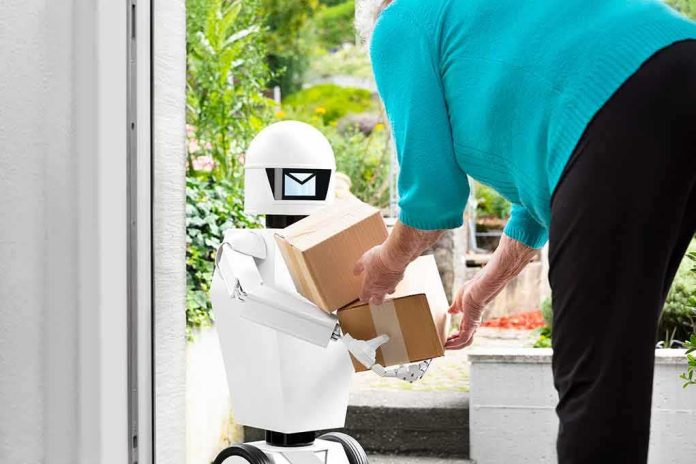
Amazon’s Ring just put a camera in the air and on wheels, and gave both a brain.
Story Snapshot
- Ring launched a new division, Ring Robotics, with two security robots.
- Ring Drone Cam flies room to room inside homes on planned patrols.
- Ring Rover Cam targets businesses with autonomous patrols and 4K video.
- Prices and dates: Rover $999.99 ships Dec. 16, 2026; Drone $249.99 in Jan. 2027.
Amazon makes mobile security the headline, not the afterthought
Ring announced Ring Robotics and led with two mobile cameras that move on their own: a flying Ring Drone Cam for homes and a wheeled Ring Rover Cam for businesses. The company set clear targets and prices, not just a demo. The Drone Cam is a compact quadcopter that can patrol “room to room,” follow routes, and return to a dock that covers the camera for privacy when idle. The Rover Cam is a ground robot for workplaces that can investigate disturbances and stream up to 4K video.
Both devices run on a named navigation stack that Ring calls AI Pilot, which maps spaces, suggests inspection points, and routes around obstacles like furniture and warehouse shelving. That label matters. It signals that automation is not a bolt-on remote control; the robots plan, move, and react in real time. The goal is simple and bold: expand the area a single system can watch without adding a wall of fixed cameras or a staff of night guards.
What ships when, and who each robot is for
Ring gave concrete timelines. The Ring Rover Cam for businesses is priced at $999.99 with United States shipments starting December 16, 2026. The Ring Drone Cam for homes is listed at $249.99 with availability slated for January 27, 2027, according to independent coverage that matched Ring’s launch details. That split also draws a bright line. The Drone Cam pitches to homeowners who want mobile checks indoors. The Rover aims at stores, offices, and warehouses that need wide patrols and higher video quality.
CNBC, Reuters, WIRED, and GeekWire each covered the launch the same day Ring went public with it, adding weight to the basic facts and the market split between home and business. That attention tracks with a clear pattern in consumer robotics: mobility plus cameras promise more coverage for less time watching feeds. The follow-through will ride on reliability, ease of setup, and how well the robots blend with existing Ring alarms, doorbells, and sensors.
How the pitch fits American security common sense
Households and small businesses want two things from security tech: prevention and proof. A mobile camera can check a noise now, not after a break-in. That aligns with a simple, conservative value: protect what you own with tools that work when you need them. If AI Pilot steers clear of pets, people, ladders, and pallets, and if alerts cut false alarms, the value case is strong. One robot roaming a floor can beat three fixed cameras that miss the blind spots.
Critics point to earlier efforts. Reports link the Rover’s concept to Amazon’s prior Astro line, whose business version ended fast and left some buyers unhappy. That history invites a fair question about long-term support and real autonomy. The counter is straightforward: Ring put dates, prices, and a named system on the table, and framed the Rover for business from day one. If the field tests match the promise, the past will fade. If not, customers will vote with their wallets.
What to watch once units reach homes and shop floors
Navigation and obstacle avoidance will define trust. GeekWire reports that AI Pilot maps and suggests points to inspect, which should cut setup time and human babysitting. Actual users will judge how fast the map updates after a furniture move, how the Drone handles ceiling fans, and how the Rover manages cords, ramps, and narrow aisles. Businesses will test whether 4K video helps catch detail that matters for loss prevention or incident review.
Amazon's Ring just launched Ring Robotics: a $250 flying security camera for homes and a $1,000 patrol robot for businesses. Both navigate on their own with AI Pilot. Drone ships Jan 27, Rover Dec 16. Source in reply. pic.twitter.com/VkrWIyobTb
— Waris Hym (@WarisHymii) November 10, 2026
Privacy and control will also matter. Ring says the Drone Cam’s dock covers the camera when parked to protect privacy. Clear controls over when patrols run, who can view clips, and how alerts link to doorbells and motion sensors will decide daily use. For families, the sweet spot is simple: it flies only when asked, shows what you need, then shuts up and sits down. For managers, the win is fewer blind spots at night and fewer hours scrubbing dull footage.
Sources:
washingtontimes.com, ring.com, aboutamazon.com, androidauthority.com, rmb.reuters.com, wired.com