

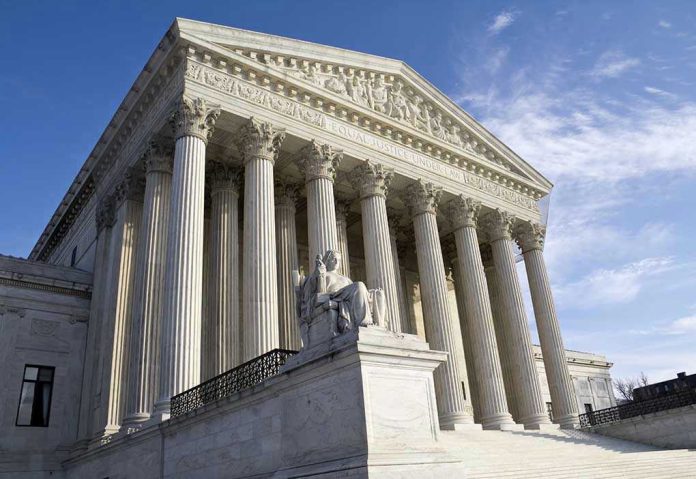
A Maine mother’s fight against her daughter’s school for secretly facilitating a gender transition without parental knowledge has reached the doorstep of the highest court in America.
Story Snapshot
- Amber Lavigne discovered school social worker gave her 13-year-old daughter chest binders and encouraged alternative pronouns without her knowledge
- Two federal courts dismissed her lawsuit on procedural grounds without addressing the constitutional parental rights questions
- Goldwater Institute has petitioned the U.S. Supreme Court to hear the case, citing a circuit court split on parental rights
- The U.S. Department of Education is investigating Maine schools for allegedly encouraging gender transitions while keeping parents uninformed
The Discovery That Changed Everything
In December 2022, Amber Lavigne made a shocking discovery about what was happening with her 13-year-old daughter at Great Salt Bay Community School in Damariscotta. Social worker Samuel Roy had provided her child with two breast binders and instructed the girl on their use. More troubling still, school officials had begun using alternative pronouns and a different name for her daughter while explicitly telling the child to keep this information from her mother.
The revelation struck at the heart of what many parents consider their fundamental right to know about significant decisions affecting their children’s mental health and physical well-being. Lavigne’s case would soon become a lightning rod in the national debate over where school authority ends and parental rights begin.
Courts Dodge the Constitutional Question
Lavigne filed her federal lawsuit in April 2023, but her journey through the court system proved frustrating. District Court Judge Jon D. Levy dismissed her case in May 2024, not because her claims lacked merit, but because she allegedly failed to provide sufficient facts to establish municipal liability. The First Circuit Court of Appeals upheld this dismissal in July 2024.
Neither court addressed the underlying constitutional question that lies at the heart of Lavigne’s case. This procedural dismissal left the fundamental issue unresolved: do parents have a constitutional right to be notified when public schools facilitate a child’s gender transition? The lower courts’ reluctance to tackle this question head-on has created exactly the kind of legal uncertainty that demands Supreme Court intervention.
A Pattern Emerges Across America
Lavigne’s case is not happening in isolation. Similar lawsuits are pending before the Supreme Court from Massachusetts and Florida, suggesting a nationwide pattern of schools implementing gender transition policies without parental notification. The Goldwater Institute, representing Lavigne, argues this creates a circuit court split that requires uniform national guidance from the nation’s highest court.
The U.S. Department of Education has opened an investigation into Maine’s Department of Education over reports that teachers and school counselors are encouraging student gender transitions while deliberately keeping parents uninformed. This federal scrutiny adds weight to claims that school policies may be systematically undermining parental authority across state lines.
The Constitutional Stakes
The Supreme Court petition raises two critical questions that could reshape American education policy. The procedural question asks whether cases can be dismissed simply because alternative explanations exist, rather than requiring that the plaintiff’s explanation be implausible. More importantly, the substantive question demands clarity on whether parents have fundamental constitutional rights to notification when schools recognize and facilitate a child’s gender transition.
Goldwater Institute attorney Adam Shelton argues the constitutional violation is clear, stating that keeping this information from Lavigne violated her rights as a parent to make important decisions affecting her child’s mental health and physical well-being. The school district maintains its actions complied with state law requirements to provide safe, inclusive environments while protecting student privacy. This fundamental disagreement between parental authority and institutional policy reflects a broader cultural battle playing out in schools nationwide.