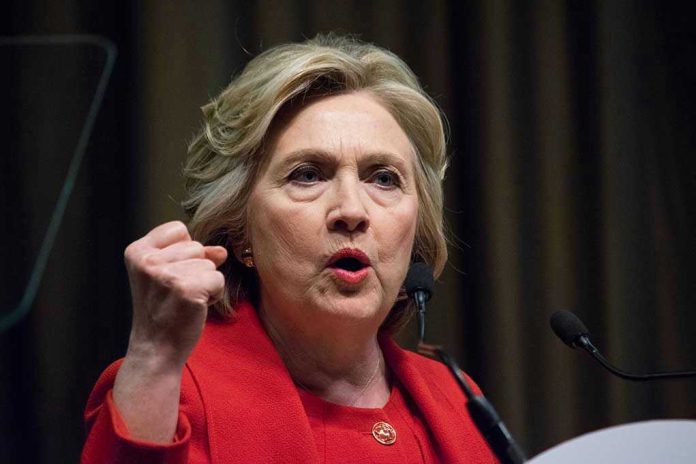
Hillary Clinton’s new “fundamental rights for women” panel is reigniting the national fight over whether “women’s rights” now includes redefining what a woman is.
Story Snapshot
- Rep. Sarah McBride (D-DE), an openly transgender member of Congress, appeared on a women’s-rights-themed panel alongside Hillary Clinton at the Munich Security Conference on Feb. 14, 2026.
- The panel’s title, “Girls Just Want to Have Fundamental Rights: Fighting the Global Pushback,” framed the discussion as a response to international resistance to women’s and gender-rights agendas.
- Conservative outlets and social media critics argue the optics undermine sex-based protections, while mainstream reporting describes McBride as a gender-rights advocate invited for her policy work.
- The available reporting confirms the event and participants, but offers limited detail on what was said in the room beyond the panel framing and basic context.
What Happened at Munich: The Panel, the Title, and the Line It Crosses for Many Voters
Rep. Sarah McBride joined Hillary Clinton at the Munich Security Conference on Feb. 14, 2026, for a session titled “Girls Just Want to Have Fundamental Rights: Fighting the Global Pushback.” Coverage identifies McBride as a transgender lawmaker and places the appearance in a broader conference agenda that mixed security policy with cultural and rights issues. For many Americans—especially parents watching schools, sports, and language change rapidly—the panel signaled that “women’s rights” debates are increasingly being routed through gender-identity politics.
Conservative backlash has centered less on foreign policy and more on definitions: the words “girls” and “women” in the panel title set expectations about sex-based rights, while the inclusion of a transgender representative sparked criticism that the category is being re-labeled in ways that can erase boundaries voters consider basic and rooted in biology. The research provided does not include full remarks or a transcript, so the strongest verified facts are the event, the participants, and the official framing of the session.
What the Reporting Actually Establishes—And What It Doesn’t
The most direct mainstream-style write-up supplied here describes McBride’s role as part of a “girls’ rights forum” and confirms Clinton’s involvement and the event’s date and location. Separately, biographical information provided in the research identifies McBride as the first openly transgender member of Congress and a high-profile LGBT political figure. However, the materials do not provide a comprehensive account of the panel’s substance, audience questions, or policy outcomes—limitations that matter when claims about motive or intent are made.
Multiple partisan sources characterize the event as “woke hypocrisy,” but those conclusions depend on interpretation rather than verifiable quotes included in the research packet. Without a full transcript, the factual foundation remains narrow: Clinton hosted or participated in the panel; McBride participated; the theme was framed as a response to “global pushback” against rights claims involving women and girls. Any more precise claim about what was argued from the stage would require additional documentation not included here.
Why This Resonates Now: The Family-Policy Flashpoint Behind the Optics
For a conservative audience that lived through years of aggressive DEI mandates, shifting school policies, and top-down cultural messaging, the controversy isn’t just about one conference panel overseas. It is about how elite institutions use language—“fundamental rights,” “girls,” “inclusion”—to advance definitions that can ripple into domestic policy fights at home. When sex-based terms are treated as interchangeable with gender identity, critics worry women’s sports, privacy spaces, and parental authority become collateral damage.
How to Read the Event in 2026: Culture Politics, Not Just a Conference Clip
In 2026, with President Trump back in office and voters demanding a rollback of progressive social engineering, this kind of headline becomes a test of whether global forums are still pushing the same cultural playbook many Americans rejected at the ballot box. The research confirms the event took place and shows competing media narratives: one side presents McBride as a rights advocate; the other sees the panel as proof the left’s “women’s rights” branding has been redefined. The gap between those narratives is exactly where the political fight now sits.
OUTRAGE! Hillary Clinton Hosts Panel on “Fundamental Rights For Women” – and Her First Guest is a Man Pretending to be a Woman: Trans Rep. “Sarah” McBride (VIDEO) https://t.co/vn2iSYd7nn
— The Gateway Pundit (@gatewaypundit) February 14, 2026
Bottom line: the verified facts support that Clinton and McBride shared a women’s-rights-branded stage at a high-profile international conference. What remains less supported—based on the limited materials provided—is any detailed, quote-level case about what specific policies were demanded or whether concrete commitments were made. Until full remarks are documented, the public debate will continue to be driven by optics and definitions—two areas where Americans are increasingly unwilling to be lectured by the same political class that presided over years of cultural upheaval.
Sources:
transgender-lawmaker-sarah-mcbride-hillary-clinton-girls-rights-forum
woke-hypocrisy-hillary-clinton-teams-with-trans-lawmaker-to-lecture-on-girls-rig-mllbz8ya
hillary-clinton-hosts-panel-fundamental-rights-women-her