

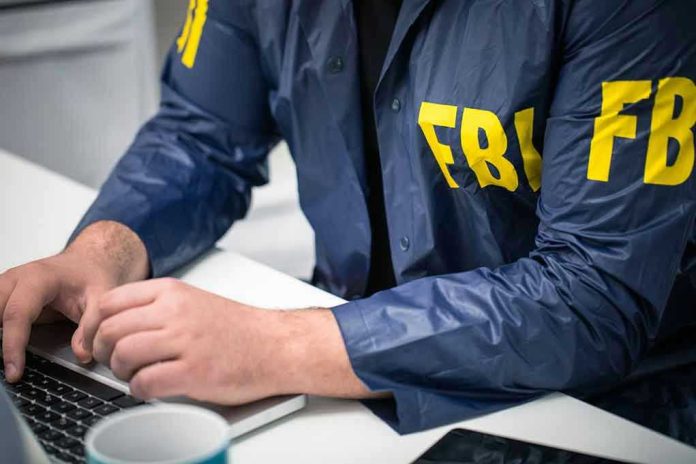
Labeling an FBI tip hotline as a “pre-crime center” may be politically explosive—but the reality is a 24/7 federal intake hub that raises fresh questions about transparency and power.
Quick Take
- The FBI’s National Threat Operations Center (NTOC) in Clarksburg, West Virginia operates as a centralized intake point for public threat tips, processing roughly 3,100 calls and electronic submissions per day.
- Available material describes a reactive triage and routing system—not predictive “pre-crime” enforcement—though independent confirmation is limited.
- Threat intake examiners gather identifying details and forward actionable information to FBI field offices or law enforcement partners.
- The story highlights a broader trust problem: many Americans across the political spectrum want security agencies to be effective but also constrained, accountable, and clearly focused.
What the FBI’s NTOC Actually Does—Based on What’s Public
The FBI describes the National Threat Operations Center as the bureau’s centralized entry point for tips from the public, operating around the clock in Clarksburg, West Virginia. In the FBI’s own depiction, staff handle about 3,100 daily phone calls and electronic tips and evaluate whether the information relates to counterterrorism, criminal counterintelligence, domestic terrorism, or other priorities. When a tip appears actionable, examiners route it to the proper FBI field office or partner agency.
That distinction matters because “pre-crime” implies prediction—government identifying would-be offenders before they act. The available research provided here does not document that kind of predictive system at NTOC. Instead, the center is presented as a high-volume triage and communications operation that depends on incoming reports. Without additional independent sources beyond the FBI’s presentation, the public has limited ability to verify how consistent real-world practice is with the promotional narrative.
How the Tip Pipeline Works and Why It Concentrates Authority
The NTOC model is a hub-and-spoke system: information enters through a single national chokepoint and then moves outward to field offices and other law enforcement partners. The FBI emphasizes that threat intake examiners answer calls, collect key details, and make decisions on how to route information for further action. Centralization can speed up sorting and reduce missed handoffs, but it also concentrates early judgment in a small group of gatekeepers.
In practical terms, this structure can be reassuring to citizens who want serious threats handled quickly, especially in an era when tips arrive from worldwide sources and include both calls and electronic submissions. At the same time, Americans who already suspect “deep state” self-protection often worry about opaque internal standards—what gets prioritized, what gets dismissed, and what gets retained. The provided material does not include published performance metrics, error rates, or outside audits that would help settle those concerns.
Why “Pre-Crime” Framing Spreads—and What It Misses
The “pre-crime” label persists because modern law enforcement increasingly relies on information systems, rapid data-sharing, and expanded reporting channels that feel distant from traditional, local accountability. The FBI’s account of NTOC stresses evolution from a basic “public access line” into a “full operations center,” including improvements in technology, staffing, infrastructure, and protocols. To skeptics, those upgrades can sound like surveillance expansion, even when the stated function is tip processing.
From a conservative, limited-government perspective, the key question is not whether tip lines should exist—they clearly should—but whether the boundaries are well-defined and visible. If the NTOC is strictly an intake-and-routing function, the responsible debate is about oversight, retention, and due process safeguards, not science-fiction prediction. If more exists beyond that, the current public record in this research set is too thin to prove it either way, and that lack of clarity itself fuels distrust.
The Broader Trend: Real-Time “Fusion” Culture at Every Level of Government
The NTOC story also lands amid a wider push for real-time crime and intelligence centers at the local and regional level, where agencies combine data, video feeds, and rapid dispatch to speed response. Supporters argue these centers help police get to emergencies faster and connect cases more efficiently. Critics argue they can normalize constant monitoring and blur the line between targeted investigation and broad, always-on observation, particularly when rules are unclear.
For citizens—right, left, and in the exhausted middle—the shared frustration is that institutions often demand trust without offering readable transparency. Republicans may emphasize constitutional limits, civil liberties, and bureaucratic restraint; Democrats may emphasize civil rights and disparate impact; both sides increasingly agree that Washington incentives reward secrecy and self-preservation. The NTOC, as presented in the available material, may be an operational necessity—but it is also another reminder that modern governance runs on systems the public rarely sees.