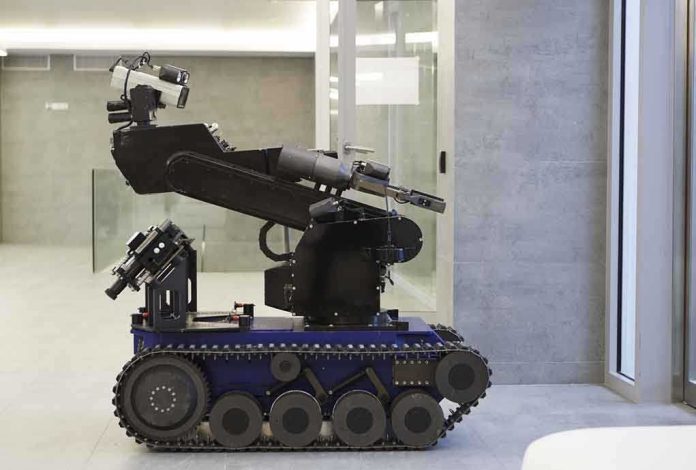
The future of warfare is here, and it’s being powered by robots that keep soldiers out of harm’s way.
Story Snapshot
- Army Special Forces are creating a permanent robotics ecosystem across all domains.
- The initiative aims to keep humans out of first contact in battle.
- Lessons from Ukraine and other conflicts are driving this transformation.
- New roles and training programs are being developed for robotics integration.
Redefining Special Operations with Robotics
The U.S. Army Special Forces are pioneering a revolutionary shift by integrating robots and autonomous systems across land, air, sea, cyber, and space domains. This initiative, driven by experiences in Iraq, Syria, and Ukraine, aims to embed these technologies permanently into military operations. By doing so, the Army seeks to keep human soldiers out of the initial line of contact with the enemy, thus enhancing the safety and effectiveness of special operations.
The creation of the Special Operations Robotics Detachment (SORD) in March 2024 marks a significant step in this direction. This unit, along with the planned 390A Robotics and Autonomous Systems Technician warrant officer specialty, is at the forefront of this change. These developments are not merely experimental but are part of a comprehensive strategy to institutionalize the use of RAS across all military domains.
Learning from Recent Conflicts
The lessons learned from recent conflicts in Ukraine and Eastern Europe have been instrumental in shaping this robotics initiative. The widespread use of drones and ground robots for reconnaissance and strike operations in these regions has demonstrated their effectiveness. These conflicts have shown that low-cost, expendable drones can significantly shape the battlefield, providing a tactical advantage against peer adversaries.
Army leaders, including Gen. James Rainey, have emphasized the moral responsibility to prevent unnecessary human casualties by using robots for initial enemy contact. This approach not only preserves human life but also enhances the operational reach of special forces, allowing them to conduct missions more effectively in contested environments.
Institutionalizing Robotics in Special Forces
The institutionalization of robotics within the Army Special Forces is a well-calculated response to the evolving nature of warfare. The establishment of dedicated units like SORD and the introduction of new roles such as the 390A warrant officer are designed to ensure that these technologies are fully integrated into military operations. The U.S. Army John F. Kennedy Special Warfare Center and School has also launched a six-week Robotics and Unmanned Systems Integration Course to prepare Green Berets and other special forces for this technological shift.
This initiative is part of a broader modernization effort that includes joint experiments like Project Convergence. These experiments are crucial for developing human-machine integration concepts that are applicable across various military contexts, including special operations. By institutionalizing robotics, the Army is not only enhancing its capabilities but also setting a precedent for future warfare strategies.
The Road Ahead: Challenges and Opportunities
While the integration of robotics into special operations presents numerous advantages, it also poses challenges. The cognitive load of managing and integrating these technologies into complex missions can be overwhelming. Therefore, specialized roles like the 390A warrant officer are essential for ensuring that RAS are effectively deployed and managed in real-world scenarios.
Army Special Forces Embracing Robots in All Domains | Story by @LauraHeckmann | #specialops #army #robots
Read now: https://t.co/jpNEAHGEJM pic.twitter.com/tLyzwFrG1M
— National Defense (@NationalDefense) December 8, 2025
In the long term, the institutionalization of robotics in special operations is expected to lead to significant changes in tactics, techniques, and procedures. Robots could act as the first echelon, conducting initial reconnaissance, jamming enemy communications, and even engaging in combat, thus minimizing risks to human soldiers. This transformation is likely to influence defense industry offerings, leading to the development of more advanced, stealthy, and interoperable robotic systems.