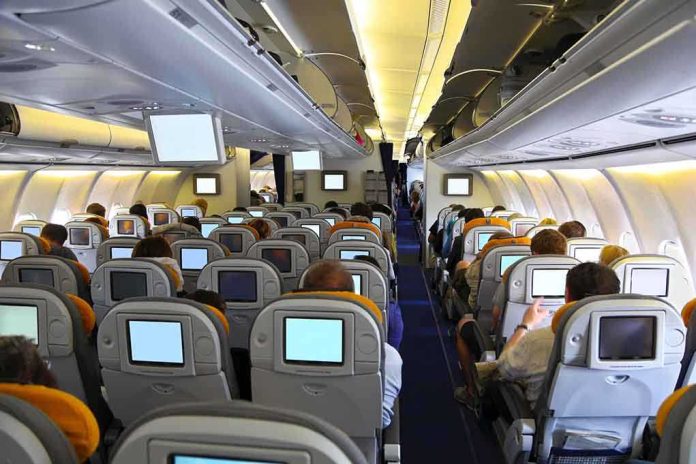
When a United Airlines passenger stood up mid-flight and unleashed a profanity-laden tirade after five hours of accumulated delays, she inadvertently created a masterclass in how modern air travel breaks people, and how professionals respond when it does.
Quick Take
- A United Airlines passenger experienced a three-hour initial delay, followed by 1.5 hours on the tarmac, then learned of another 1.5-hour wait with the aircraft 30th in line for takeoff
- Her explosive outburst was captured on video and went viral across social media platforms, sparking widespread discussion about passenger behavior and airline operations
- Flight crew members responded with remarkable professionalism, maintaining composure and safety protocols despite extreme provocation
- The incident highlights the convergence of operational failures, passenger uncertainty, and the social media amplification of human frustration at its breaking point
The Perfect Storm of Delay and Desperation
Five hours is a long time to watch your life derail. The passenger boarded expecting a flight to Charleston, South Carolina, only to discover she’d already spent three hours waiting before takeoff. After boarding and sitting on the tarmac for another ninety minutes, the pilot’s announcement delivered the final blow: the aircraft was thirtieth in line for departure with an estimated additional hour and a half ahead. That’s when something inside her broke.
This wasn’t random air rage. This was the predictable outcome of cascading failures, each delay compounding the psychological weight of the previous one. By the time she stood up and began her profanity-laced complaint, she’d already invested five hours of her life into a journey that should have taken two. The mathematics of frustration are simple: delay plus uncertainty plus powerlessness equals explosion.
When Professionals Meet Chaos
What makes this incident remarkable isn’t the passenger’s outburst. Air rage happens. What distinguishes this moment is how United’s flight crew responded. A fellow passenger who recorded the incident described the crew as “absolute angels,” noting their calm demeanor amid the chaos. The flight attendant initially allowed the passenger to stand, respecting her right to express her frustration, while maintaining professional boundaries and safety protocols.
The crew didn’t escalate. They didn’t match her energy or her language. They de-escalated, documented, and eventually made the difficult but necessary decision to return to the gate and remove the passenger. This wasn’t heavy-handed authority; it was measured crisis management executed under genuine pressure. The pilot chose safety over schedule recovery, a decision that prioritizes passenger welfare over operational metrics.
The Social Media Amplification Effect
Twenty years ago, this incident would have been a story told at dinner tables and forgotten by the following week. Today, it becomes a viral phenomenon that generates hundreds of thousands of views and spawns countless social media discussions about passenger rights, airline accountability, and crew professionalism. The recording passenger’s decision to share the incident, and crucially, to praise the crew’s response, created a nuanced narrative that transcends simple condemnation.
This complexity matters. The incident simultaneously criticizes the passenger’s behavior, acknowledges legitimate frustrations with airline operations, and celebrates professional crisis management. Social media gave voice to all three perspectives simultaneously, creating a more complete picture than traditional media’s tendency toward sensationalism or oversimplification.
What This Reveals About Modern Air Travel
This incident exposes the structural stress built into contemporary aviation. Increased passenger volume, more complex regulations, frequent policy changes, and the omnipresent recording devices create an environment where human frustration reaches critical mass more frequently than in previous decades. Passengers feel less control, less certainty, and more surveillance. Crews face more aggression from increasingly stressed travelers. Airlines manage operational complexity that would have been unimaginable a generation ago.
The incident suggests that occasional explosions aren’t aberrations in the system, they’re inevitable features of it. The question isn’t whether air rage will continue happening. It will. The question is whether airlines will invest in better operational transparency, more realistic delay communication, and continued training for crews to manage these moments with the professionalism demonstrated on this Newark-to-Charleston flight.
Sources:
AOL – Viral Newark airport video sparks discussion
AS.com – Southwest Airlines passenger incident context
Aviation A2Z – United Airlines passenger removed on delayed Newark to Charleston flight