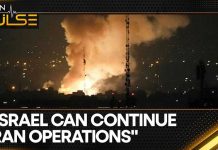
President Trump has delivered a stark 48-hour ultimatum to Iran as Operation Epic Fury enters its 23rd day, demanding the regime reopen the Strait of Hormuz or face obliteration of remaining military assets.
Story Snapshot
- Trump issues 48-hour deadline for Iran to reopen Strait of Hormuz as war enters day 23
- U.S.-Israeli forces have destroyed nearly 2,000 Iranian targets including 19 ships, 1 submarine, and critical command infrastructure
- Defense Secretary Hegseth confirms U.S. controls the conflict timeline with overwhelming military superiority
- Over 2,000 deaths reported across the region as nine countries become involved in escalating conflict
Trump Administration Delivers Ultimatum on Hormuz Blockade
President Trump issued a direct 48-hour ultimatum to Iran’s interim leadership demanding the immediate reopening of the Strait of Hormuz, the critical waterway through which roughly 20 percent of global oil supplies transit. The President’s stark message warned that failure to comply would result in the obliteration of Iran’s remaining military infrastructure. This ultimatum comes as Operation Epic Fury enters its 23rd day, with U.S. and Israeli forces maintaining air dominance and systematically dismantling Iranian military capabilities. The administration’s hardline stance reflects its commitment to protecting global energy markets and preventing Iran from weaponizing critical international shipping lanes.
Devastating Military Achievements Against Iranian Regime
U.S. and Israeli forces have achieved unprecedented military success since Operation Epic Fury launched on February 28, 2026. The initial 12-hour assault involved nearly 900 strikes targeting Iranian military infrastructure, air defenses, and regime leadership. By March 4, coalition forces had destroyed 19 Iranian ships, including the missile corvette IRIS Shahid Soleimani, and sunk Iran’s only operational Fateh-class submarine—the first submarine sunk in combat since the Falklands War. The IDF reported destroying 300 Iranian missile launchers, the Supreme National Security Council headquarters, command-and-control infrastructure, and even a covert nuclear site. This systematic destruction has effectively crippled Iran’s ability to project military power.
Defense Secretary Confirms U.S. Military Dominance
Defense Secretary Pete Hegseth delivered a forceful message emphasizing America’s overwhelming military advantage and resolve to sustain operations indefinitely. Hegseth stated that U.S. combat power continues building while Iranian capabilities decline precipitously, and that munitions stockpiles remain “full up.” His assertion that “our timeline is ours and ours alone to control” underscores the administration’s determination to dictate the conflict’s duration and intensity. This contrasts sharply with previous administrations’ hesitancy to commit American power decisively. Secretary of State Marco Rubio announced on March 4 that attacks would increase in intensity, signaling escalation rather than negotiation—a strategy aligned with achieving total Iranian capitulation.
Strategic Context and Regional Implications
The 2026 Iran War represents the culmination of a 50-year shadow conflict between America and Iran’s revolutionary regime, which has cost nearly 1,000 American lives over five decades. The Trump administration’s decision to launch Operation Epic Fury followed Iran’s brutal crackdown on protesters in January 2026, when security forces killed at least 30,000 demonstrators according to Iran’s own Ministry of Health. This unprecedented violence triggered the largest U.S. military buildup in the Middle East since the 2003 Iraq invasion. The initial strikes specifically targeted Supreme Leader Ali Khamenei before he could go into hiding, successfully eliminating the regime’s top leadership. By March 3, nine countries had become involved in the expanding conflict.
Iranian Retaliation and Civilian Casualties
Iran has launched retaliatory missile and drone strikes targeting U.S. embassies, military installations, and regional oil infrastructure throughout the Middle East. Two Iranian drones struck the U.S. embassy in Riyadh, causing fires and forcing closure. Pro-Iran militant groups claimed responsibility for over 23 drone strikes on U.S. assets in Erbil. More than 2,000 people have been killed across Iran, Lebanon, and Israel since operations commenced. Tragically, approximately 170 people died when a U.S. missile struck a girls’ school adjacent to a naval base in Minab on February 28. While civilian casualties are regrettable, they underscore the Iranian regime’s longstanding practice of deliberately positioning military assets near civilian infrastructure to exploit such tragedies for propaganda purposes.
Economic Warfare and Global Energy Security
The U.S. bombing of Kharg Island on March 13 struck at the heart of Iran’s economic capacity, destroying what Trump described as every military site on the major oil export hub. This action threatens to eliminate Iran’s ability to fund terrorism and proxy warfare while simultaneously protecting global energy markets from manipulation by a rogue regime. Iran’s apparent closure of the Strait of Hormuz—the trigger for Trump’s 48-hour ultimatum—represents an act of economic warfare against the entire world. The administration’s decisive response demonstrates that America will not tolerate Iran holding global commerce hostage. This represents the kind of strength-based diplomacy that protects American interests and those of our allies worldwide.
Sources:
Timeline of the 2026 Iran war – Wikipedia
War US-Israel vs Iran Timeline 2026
Iran’s 50-Year War on America: Timeline of Terror – Washington Times