One $60 million Navy jet vanished off the side of a US aircraft carrier in seconds, and the most troubling part is how preventable it looks on paper.
Story Snapshot
- A Super Hornet’s landing on USS Harry S. Truman ended with a boom, sparks, and a slide into the Red Sea
- The pilot lived, but the jet became one of three Super Hornets lost on a single deployment
- Investigations point to leadership, maintenance, and training failures—not enemy fire
- Roughly $164 million in equipment evaporated in mishaps that should alarm every taxpayer
How A Routine Trap Turned Into A $60 Million Slide
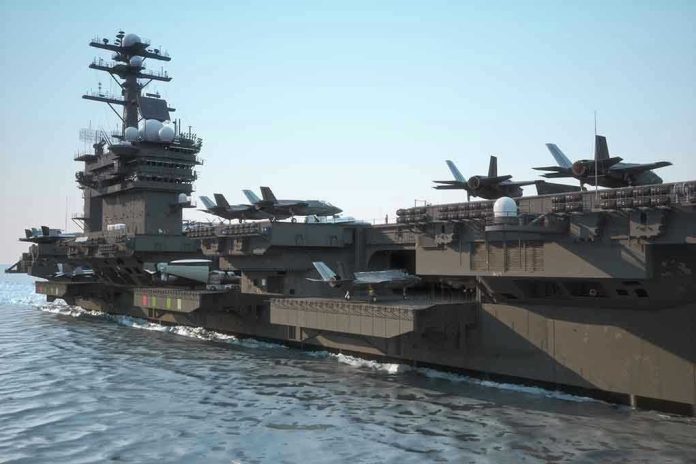
The F/A‑18E Super Hornet was not dodging missiles, dogfighting enemy jets, or limping home with battle damage when things went wrong. It was doing the most practiced move in carrier aviation: coming back to the ship. As the jet hit the deck of USS Harry S. Truman in the Red Sea, the nose gear touched, a boom sounded, sparks flew, and a critical part of the landing‑gear system failed. In seconds, the aircraft’s recovery unraveled and directional control disappeared.
With a boom and sparks, this $60 million Navy jet's aircraft carrier landing unraveled in seconds https://t.co/ztK7OBQsxH via @businessinsider .@JonLemire
— Terri Savage (@KTSavage) December 6, 2025
Once the main landing‑gear uplock system failed, the Super Hornet no longer behaved like a 21st‑century fighter with layers of engineered safeguards. It behaved like a 40,000‑pound object with momentum on a confined, steel runway at sea. The jet slid across the landing area, over the edge, and into the Red Sea. The pilot ejected and survived, but the aircraft was gone for good, one more data point in a worrying record for that deployment.
One Mishap In A Pattern Of Preventable Losses
The boom‑and‑sparks landing was not a freak, one‑off tragedy; it was one of three Super Hornets lost from Truman on a months‑long Middle East and Red Sea deployment. Another jet went overboard during a hard evasive turn when Houthi forces fired a ballistic missile, sending the carrier into an abrupt maneuver. That aircraft and its tow tractor slid off the deck after bad brakes, degraded non‑skid surface, and weak communication lined up like dominoes.
Across the cruise, Truman’s air wing also suffered at least one collision and additional mishaps that pushed estimated losses to about $164 million in aircraft and equipment. These were not cheap drones or expendable test beds; they were front‑line strike fighters America relies on to project power and deter adversaries. Command investigations, later obtained by USNI News and local media, do not describe a cursed ship or unlucky deployment. They describe a chain of leadership missteps, training holes, and maintenance corners that made accidents more likely.
What The Investigations Say About Leadership And Maintenance
Navy investigators dug into the cluster of mishaps and consistently found avoidable factors: maintenance that did not catch problems, landing‑gear and brake issues, crew communication breakdowns, and a deck surface whose non‑skid friction had not kept up with the ship’s operational tempo. The landing‑gear failure that doomed the $60 million Super Hornet raised questions not just about a single part, but about how rigorously those critical systems were inspected, documented, and supervised on a high‑tempo combat deployment.
The evasive‑turn overboard loss exposed similarly basic lapses. A carrier in missile‑threat waters will maneuver hard; that is expected. What the investigation highlighted was that the jet and tractor sitting on deck were not fully protected against that predictable risk. Brakes, chocks, communication between bridge and deck, and the worn non‑skid surface all featured in the findings. That lineup supports what conservative common sense would conclude: when simple, well‑understood safeguards erode, million‑dollar assets and human lives are put in needless danger.
What This Means For Readiness, Accountability, And Taxpayers
Losing three Super Hornets on one deployment is not just a line item on a spreadsheet; it is a hit to combat readiness. Each aircraft lost narrows sortie capacity, stresses remaining airframes, and forces the Navy either to pull jets from elsewhere or live with reduced flexibility in a dangerous region. Replacement costs push procurement and operations budgets higher, while adversaries pay nothing to benefit from American self‑inflicted losses.
The broader concern is what this cluster of accidents says about safety culture. USNI News reported that investigators tied the Truman mishaps to preventable failures in leadership, training, and equipment upkeep. That picture aligns with decades of aviation safety research: disasters rarely come from a single dramatic error. They come from layers of small, tolerated problems finally lining up. From a conservative lens, the lesson is not to demand perfection but to demand discipline—on maintenance logs, on deck procedures, on leadership accountability—before the next boom and spray of sparks sends another jet over the side.
Sources:
With a boom and sparks, this $60 million Navy jet’s aircraft carrier landing unraveled in seconds
$164M lost due to incidents during USS Harry S. Truman’s latest deployment, docs show
Investigations show failures behind carrier Harry S. Truman collision, loss of 3 Super Hornets