

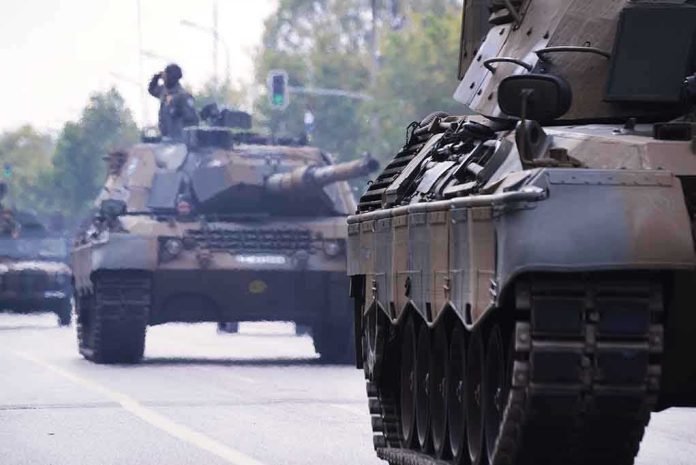
The U.S. Army is quietly ripping out thousands of tons of armor and betting America’s next ground wars on pickup-truck brigades packed with drones and data.
Story Snapshot
- The Army is converting all Infantry Brigade Combat Teams into leaner, Mobile Brigade Combat Teams centered on light vehicles and drones.
- Washington’s 81st Stryker Brigade Combat Team is the flagship pilot, shedding Strykers for Infantry Squad Vehicles over about three years.
- Leaders say they are trading weight and mass for speed, dispersion, and digitally networked lethality in high-threat, drone-saturated battlespaces.
- Guard formations will shrink from roughly 4,200 troops to about 2,500–2,700 per MBCT, with more unmanned systems pushed down to squads and platoons.
The Army’s decisive break from the Stryker era
U.S. Army leaders did not bury the lede when they signed the Army Transformation Initiative letter on May 1, 2025: every Infantry Brigade Combat Team would become a Mobile Brigade Combat Team, and the service would “trade weight for speed, and mass for decisive force.” The move ends a two-decade experiment in medium-weight Stryker formations and pivots toward smaller, lighter, faster units meant to survive under precision fires and constant surveillance.
The Washington Army National Guard’s 81st Stryker Brigade Combat Team at Joint Base Lewis-McChord is the first high-profile proof of concept. After spending its earlier life as a heavy armored brigade and then converting to Strykers in 2015, the 81st is now turning in its 8×8 armored vehicles and reorganizing around the Chevrolet Colorado–based Infantry Squad Vehicle. Army Recognition reporting describes a phased, roughly three-year conversion that replaces armor with mobility, drones, and digital command-and-control.
Why the Army is betting on mobility, dispersion, and drones
Army planners watched the same battlefield videos everyone else did from Ukraine: columns of armored vehicles shredded by loitering munitions, big headquarters lit up by precision rockets, and any formation that massed for long becoming target practice for cheap drones. Senior leaders concluded that survivability now depends less on thick steel and more on staying dispersed, moving constantly, and hiding electronically in a sky full of sensors. That logic drives the MBCT’s leaner headcount and lower physical and electromagnetic signature.
Training data hardened that instinct. At one Joint Multinational Readiness Center rotation, a brigade commander reported that 90 percent of fire missions were observed through drones, while the unit fired 50 percent fewer artillery rounds yet achieved roughly triple the lethality. Those results reinforced the decision to push small unmanned aircraft and loitering munitions deep into squads and platoons, backed by new reconnaissance and multipurpose companies designed to find, fix, and strike faster than a heavier enemy can react.
How the Mobile Brigade reshapes the National Guard
The Army National Guard is not skirting this revolution; it is being remade by it. Guard leaders describe an end state with just two Armored Brigade Combat Teams and 25 Mobile Brigade Combat Teams across the force, a stark reversal from the tank-heavy Cold War template. A typical Guard MBCT will number about 2,500 to 2,700 soldiers including support elements, down from roughly 4,200 in a legacy infantry brigade, with that manpower and sustainment savings plowed into mobility, sensors, and connectivity instead of armor and fuel.
The 81st is the marquee Stryker-to-Mobile case, but it is not alone. At least three brigades are already in transition, and the Virginia National Guard’s 116th IBCT has officially completed its conversion to an MBCT. Senior Guard officers tout these units as “leaner, lighter, more agile, more survivable” and are steering them through upcoming Joint Readiness Training Center rotations where they will face seasoned opposing forces that have spent years learning how to hunt large signatures and slow-moving logistics tails.
The strategic gamble: lighter forces for harder wars
Army transformation documents and congressional research describe MBCTs as tools for the most contested theaters on the map: Eastern Europe under Russian-style long-range fires, the Arctic’s bare infrastructure and brutal logistics, and the Indo-Pacific’s island chains where airlift is precious and bases are targets. In those environments, leaders argue that an Infantry Squad Vehicle you can sling under a helicopter or load by the dozen into cargo aircraft is more valuable than a heavier Stryker that arrives late, in small numbers, and lights up thermal imagers.
From a conservative, common-sense perspective, the core question is not whether mobility matters—of course it does—but whether the Army is thinning out armor faster than real-world combat has earned. The plan still retains heavy armored brigades for shock action, yet watchdogs and some lawmakers warn that shrinking brigade manning and removing protection at scale could tempt adversaries to probe more aggressively. The answer will not come from PowerPoint; it will come from hard training, war games, and how well these mobile brigades actually survive against modern kill chains.
Sources:
U.S. Army transforms Washington-based 81st Stryker Brigade into new mobile combat team
Infantry brigades shift to mobile brigades in Army transformation
Battle Rhythm: Guard Transforms Alongside Active Force
Letter to the Force: Army Transformation Initiative
Washington Army National Guard selected for new mobile brigade
Congressional Research Service overview of Mobile Brigade Combat Teams
116th IBCT officially converted to Mobile Brigade Combat Team