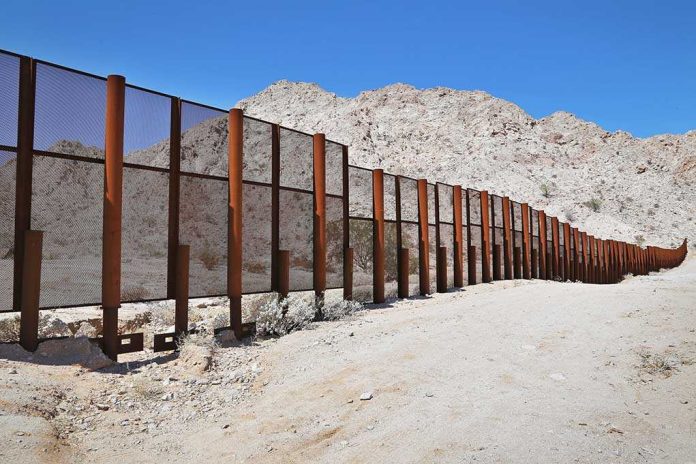
The Trump administration is deploying an unprecedented AI-powered surveillance network along America’s borders that will track movements with autonomous systems capable of operating without human oversight—raising serious questions about government overreach and privacy rights.
Story Snapshot
- DHS plans to deploy 542 new AI-enabled surveillance towers and upgrade 348 existing systems under a $100 million contract through 2030
- New mobile surveillance units mounted on 4×4 vehicles can operate autonomously using AI technology originally developed for war drones
- Congress allocated $160 billion for immigration enforcement, representing a 65% increase in DHS funding
- Facial recognition systems initially designed for border use are now tracking U.S. citizens during interior enforcement operations
Massive Expansion of Border Surveillance Infrastructure
The Department of Homeland Security is deploying 542 new integrated surveillance towers along U.S. borders while modernizing 348 legacy systems under a $100 million contract running through May 2030. Major defense contractors including General Dynamics Information Technology, Elbit Systems of America, and Advanced Technology Systems secured positions on a $1.8 billion modernization contract in 2024. Anduril Industries has already installed hundreds of autonomous surveillance towers since 2019, creating a foundation for this expanded “smart wall” infrastructure. The deployment represents the most significant technological upgrade to border enforcement infrastructure in American history.
Autonomous AI Systems Operating Without Human Oversight
The new Modular Mobile Surveillance System (M2S2) features AI-powered observation towers mounted on standard 4×4 vehicles capable of operating in two modes: attended with agents present, or unattended with autonomous AI surveillance. These systems detect motion several miles away, with AI pinpointing target locations within 250 feet of actual positions. The technology uses computer vision originally developed for military drones, analyzing thousands of images frame-by-frame to distinguish between people, animals, and vehicles. Video, maps, and sensor data are retained for at least 15 days and classified as Controlled Unclassified Information, with deletion locked “under any circumstances.” This represents a dramatic shift toward autonomous government surveillance with minimal human decision-making.
Privacy Concerns as Facial Recognition Expands Beyond Borders
ICE agents are increasingly using Mobile Fortify, an AI facial recognition tool initially developed for CBP, during interior enforcement operations—including identifying U.S. citizens without their consent. According to February 2026 New York Times reporting, this technology is being deployed for identity verification tasks it wasn’t originally designed to perform. Beryl Lipton of the Electronic Frontier Foundation warns that these autonomous towers are “capable of taking high-resolution images that the government could theoretically analyze later,” challenging DHS claims that detection-only systems don’t impact rights. The EFF emphasizes that “border enforcement doesn’t stop at the line on the map or the moment of crossing,” highlighting how surveillance capabilities originally justified for border security are now tracking Americans throughout the interior.
Questions About Effectiveness and Environmental Impact
Policy analysts question the actual security benefits of this massive infrastructure investment. Kathleen Bush-Joseph of the Migration Policy Institute notes that while “infrastructure can be strategically effective, helping funnel crossings towards places where agents are located,” the dominant drivers for reduced border crossings have been increased Mexican enforcement and Trump administration deterrence campaigns—not surveillance technology. DHS Secretary Kristi Noem reports border crossings are at a 50-year low, but the marginal impact of surveillance infrastructure remains unclear. Environmental organizations and Native American tribes warn about impacts on endangered wildlife, disrupted water flows during seasonal rains, and damage to sensitive ecosystems in Big Bend and Arizona from both bollard construction and surveillance infrastructure including stadium-style floodlights.
The $160 billion allocation from Congress’s “One Big Beautiful Bill” represents the largest expansion in DHS history, funding a surveillance network that extends far beyond border zones. While securing borders remains a legitimate government function, Americans should remain vigilant about surveillance systems capable of autonomous operation and interior tracking of U.S. citizens. The convergence of unlimited funding, advanced AI capabilities, and minimal oversight creates concerning precedents for government monitoring powers that could affect law-abiding Americans’ constitutional rights to privacy and freedom of movement.
Sources:
DHS, CBP Integrated Surveillance Tower Contract – GovConWire
DHS Seeks AI-Powered Mobile Surveillance Trucks for Border – TechBuzz.ai
AI Texas ICE MN Tech – The Marshall Project