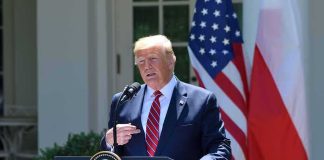
President Trump just told colleges to stop treating athletes like free-agent mercenaries—or risk losing federal money.
Story Snapshot
- Trump signed an executive order on April 3, 2026, aimed at stabilizing college sports amid NIL and transfer “Wild West” upheaval.
- The order sets a five-year eligibility window and generally limits athletes to one transfer, with exceptions such as graduate transfers and military or missionary service.
- It calls for revenue-sharing while directing protections for women’s sports and Olympic/non-revenue programs that many schools say are financially vulnerable.
- Federal agencies are instructed to evaluate compliance and potential consequences, including the possibility of federal funding being put at risk for schools that refuse to follow the rules.
What Trump’s Order Does—and Why It Landed Like a Shockwave
President Donald Trump signed the “Urgent National Action to Save College Sports” executive order on April 3, 2026, with an effective date of Aug. 1. The centerpiece is structural: a five-year eligibility limit for college athletes and a general cap of one transfer within that period, while allowing defined exceptions such as graduate transfers and time away for military or missionary service. The order also pushes revenue-sharing, while emphasizing protections for women’s and Olympic sports.
Federal involvement is the accelerant. The White House fact sheet frames the order as a stability-and-fairness intervention after years of rapid change in how athletes move, get compensated, and sign NIL deals. The order directs parts of the federal bureaucracy to assess conduct and compliance, raising the stakes for universities that receive federal dollars. That leverage matters because it attempts to make college sports rules enforceable outside the NCAA’s own shifting policies.
The Real Backdrop: NIL, Unlimited Transfers, and Courtroom Pressure
College sports entered this period after a cascade of legal and market disruptions. The Supreme Court’s 2021 NCAA v. Alston decision weakened long-standing NCAA limits on athlete benefits, and the NIL marketplace expanded quickly afterward. Meanwhile, the transfer environment evolved into something closer to perpetual roster churn, especially in revenue sports. Conference realignment and financial pressure added fuel, leaving schools trying to protect non-revenue programs while competing for talent in football and basketball.
The executive order is not Trump’s first attempt to shape this space. A prior 2025 order focused more heavily on scholarships and protecting opportunities in non-revenue sports, while the 2026 order reaches directly into eligibility and transfers. That escalation is why the reaction split quickly: some leaders welcomed a firmer standard, while others warned that the legal and practical authority for these mandates could be tested in court. Even supporters acknowledged that Congress, not just the White House, may be needed.
Supporters See Stability; Critics See a Legal Mess Waiting to Happen
University leaders and the NCAA signaled qualified support, arguing that a predictable framework could slow the sport’s drift toward pay-for-play chaos and constant movement. NCAA President Charlie Baker described the move as significant while still pressing for federal legislation, a key detail because it implies the order alone may not settle the biggest legal fights. Some coverage highlighted that the new rules could protect women’s and Olympic sports from being sacrificed to fund ever-growing spending in revenue programs.
Critics, including analysis focused on legal vulnerabilities, argued the order may invite lawsuits precisely because it tries to reshape a marketplace already under heavy antitrust scrutiny. Some reporting also raised the question of “retroactive-like” disruption—how a new eligibility or transfer framework could upend athletes whose careers were planned under a different set of expectations. Commentators pointed to hypotheticals around NCAA tournament rosters to illustrate how quickly a hard eligibility cap could change who is allowed to play.
Why Federal Funding Leverage Is the Most Politically Explosive Piece
The order’s biggest political weapon is its linkage—directly or indirectly—to federal funding consequences for non-compliance. That approach fits a broader Trump-era pattern of using executive authority to pressure institutions, but it also creates obvious questions about implementation and limits. Some reporting noted past friction where funding threats did not play out as cleanly as promised. Whether the Education Department and other agencies can practically police athletic eligibility and transfers at scale remains an open question.
For conservatives frustrated by elite institutions, the funding lever will read as overdue accountability: universities and athletic departments took in massive revenue, expanded bureaucracies, and tolerated a chaotic system that often looks unfair to fans and smaller programs. For liberals and civil-liberties skeptics, the same lever looks like Washington using taxpayer-backed power to micromanage a private-adjacent sports economy. Either way, it underscores a shared reality: Americans increasingly see governance by executive action rather than durable law.
What happens next depends on three moving parts: agency implementation, NCAA/conference responses, and the courts. The administration is urging Congress to step in, but in a polarized environment even “fix the system” ideas can stall. If schools rush to comply to avoid risk, athletes and coaches may face immediate roster disruptions for the 2026–27 cycle. If schools challenge the order, the industry could get what it least wants—yet another sprawling legal war layered on top of the one already underway.
Sources:
Trump’s college sports executive order adds chaos to an already wild legal war
Trump signs executive order to restore order, fairness in college sports: White House
Executive order limits NCAA athletes to five years, one transfer
Trump college sports order: How it could have impacted Final Four
UNC leaders release statement in response to Trump executive order on college athletics
Power 4 college sports conferences react to Trump’s latest executive order
Crawford: What could trip up Trump’s college sports executive order
FACT SHEET: President Donald J. Trump Takes Urgent National Action to Save College Sports
Donald Trump plans executive order to ‘solve every problem’ raised on college sports panel
Urgent National Action to Save College Sports