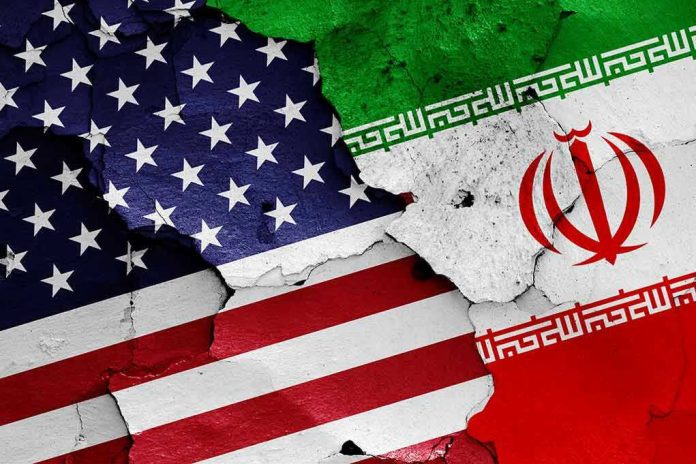
Trump’s Strait of Hormuz ultimatum was pulled back at the last moment, even as U.S. officials said Iran had already seeded the world’s most critical oil chokepoint with mines.
Quick Take
- President Trump postponed a deadline demanding Iran reopen the Strait of Hormuz after what he called “good and productive” peace talks conducted through mediators.
- U.S. intelligence assessed Iran placed more than a dozen mines in the Strait, a move that could disrupt a route tied to over 20% of global oil flows.
- Iran denied direct talks, portrayed Trump’s shift as a retreat, and warned of retaliation—including attacks on energy infrastructure and mining the Persian Gulf.
- U.S. Central Command reported large-scale strikes in the conflict, while the White House framed the broader campaign as preventing an Iranian nuclear threat.
Trump pauses the deadline while indirect talks move through mediators
President Donald Trump set a Monday-evening ultimatum for Iran to reopen the Strait of Hormuz, warning that failure could trigger U.S. strikes on Iranian power plants. Later Monday, Trump said he was postponing the deadline after mediator-driven discussions he described as “very good and productive.” According to the reporting, U.S. “points” were delivered via friendly countries for Iran to review, signaling a pause—not a reset—in the pressure campaign.
Iran’s response immediately disputed Trump’s framing. Iranian officials denied direct negotiations and insisted any messages were handled through intermediaries and evaluated under Iran’s “principled positions.” Tehran also tried to flip the narrative, claiming Trump backed down out of fear. That split-screen messaging matters because it shows both governments selling strength at home while quietly testing whether a narrower deal—especially on escalation at sea—is still possible.
Mines in the Strait raise the real-world stakes beyond rhetoric
U.S. intelligence assessed Iran had placed at least a dozen mines in the Strait of Hormuz, a step that turns a political standoff into a concrete economic risk. The Strait is a narrow corridor that carries a massive share of global oil shipments, so even partial disruption can ripple into fuel prices and inflation. The research also notes Iran threatened broader mining in the Persian Gulf, echoing tactics used in earlier regional maritime clashes.
The threat is not theoretical. During the 1980s “Tanker War,” Iran’s mining campaign created a hazardous cleanup problem that required extensive counter-mine activity, and the research points to that precedent to explain why mines can be a slow-burn crisis. In practical terms, a mine threat pressures U.S. allies in the Gulf, raises shipping insurance costs, and forces navies to choose between deterrence patrols and time-consuming clearance operations—often under the risk of escalation.
Competing claims: “productive talks” versus “no direct contact”
Trump publicly suggested Iran initiated outreach and claimed conversations involved a top Iranian official, with reporting raising the possibility of parliamentary speaker Mohammad Bagher Qalibaf. Iran’s government rejected that account and said no direct talks occurred, while leaving open that messages passed through friendly countries. The contradiction is unresolved in the research, and it highlights how diplomacy can be happening in parallel with disinformation, domestic posturing, and intentional ambiguity.
The research also describes an unanswered proposal for a direct meeting, underscoring the limits of what is confirmed. For Americans trying to sort signal from noise, the key verified point is procedural: mediators are passing messages, and Washington temporarily paused a hard deadline while those messages are reviewed. That may reduce the immediate chance of a dramatic strike on power plants, but it does not remove the core dispute or the maritime danger.
How the broader campaign fits the “maximum pressure” strategy
U.S. Central Command reported extensive operational activity, including thousands of strikes and significant damage to Iranian naval assets during the ongoing war described in the research. The White House fact sheet positions the administration’s approach inside a larger “maximum pressure” framework rooted in Trump’s first-term policies, including withdrawal from the 2015 nuclear deal and designation of the IRGC as a terrorist group. The White House also cites prior operations targeting Iran’s nuclear infrastructure.
From a conservative, limited-government perspective, the most important domestic takeaway is the economic vulnerability created when hostile regimes can squeeze global energy supply through narrow choke points. Voters who are already skeptical of high energy costs and inflation will see the Strait issue as more than foreign policy theater, because shipping disruptions can reach U.S. households fast. At the same time, the research does not provide independent verification for every battlefield claim, so conclusions should stick to confirmed statements and documented assessments.
Sources:
Trump Calls Off Strait of Hormuz Ultimatum Amid Reported Peace Talks with Iran