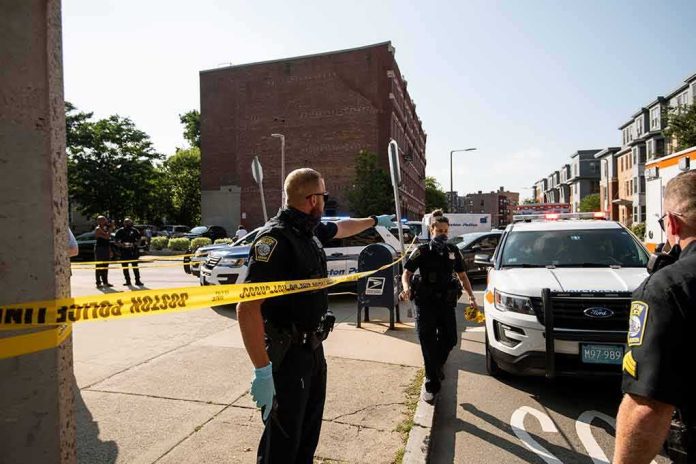
New bodycam footage of a 13-year-old girl rescued from a Jacksonville motel shows law enforcement at its best, even as it raises hard questions about why families must rely on dramatic raids instead of a justice system that prevents these crises in the first place.
Story Snapshot
- A 13-year-old Georgia girl was tracked over 130 miles and rescued from a Jacksonville motel room.
- Bodycam video shows a SWAT team and multiple agencies racing to save her after an Amber Alert.
- Police say her biological mother and a man without legal custody took her and now face kidnapping charges.
- The case highlights both the power of joint police work and the gaps in a system that fails at basic child protection.
Dramatic rescue of a missing Georgia teen in Florida
Jacksonville Sheriff’s Office body camera video shows the tense moments officers moved in on a room at the Scottish Inn on Philips Highway to recover a missing 13-year-old girl taken from her Georgia home. Investigators say the teen was brought more than 130 miles across state lines before they tracked her to the motel and formed a perimeter around the building. The scene looks like something from a movie, but it was real life for a child at the center of an Amber Alert.
As officers approached, video and local reports describe 42-year-old Jonathon Kelly rushing out of the room, jumping into a vehicle, and trying to escape. Police say he nearly hit a SWAT truck before crashing into the motel itself, where he was quickly taken into custody. Inside the room, officers found the 13-year-old alive and were able to escort her out to safety. According to Jacksonville authorities, she is now receiving support and resources after the ordeal.
Who the suspects are and how police say the abduction happened
Jacksonville investigators and Georgia officials say the teen was taken from her home by her biological mother, who did not have legal custody, and by Kelly, the man seen fleeing in the video. News reports based on police accounts state that neither adult had the legal right to take or keep the girl, turning an already tense family situation into a serious criminal case. Both suspects now face multiple charges, including kidnapping and home invasion, according to authorities.
Local coverage describes the incident as starting at the girl’s Georgia home, where the mother allegedly showed up in violation of custody rules and left with the child. Law enforcement in Georgia quickly treated it as a high-risk missing-child case and requested help. An Amber Alert spread the teen’s description and the suspected vehicle across the region. What followed was a multiagency push to find her as fast as possible, using tools that are rarely explained to the public in detail.
Multiagency operation and the growing role of police video
The rescue was not handled by one agency alone. The Jacksonville Sheriff’s Office says the SWAT team worked alongside the Federal Bureau of Investigation (FBI) and the Georgia Bureau of Investigation (GBI) to reach the girl in time. This kind of cross-state operation is becoming more common in child abduction cases, where phone data, cameras, and quick alerts can shrink the window of danger. Officials framed the outcome as proof that “every second matters, and every life matters” when agencies work together.
Body-worn camera and motel surveillance video now shape how the public sees these events. In this case, news outlets led with dramatic clips of officers with long guns, armored vehicles, and a frantic suspect trying to run. For many viewers, that video feels like undeniable proof of what happened. It can build trust in everyday officers who risk their lives, but it also lets agencies control the story by choosing which moments to show and which records to hold back, such as custody orders or 911 call audio.
What we still do not know and why it matters
Even with powerful video, key pieces of the legal story remain out of sight. The public record here does not yet include the family-court documents that spell out the mother’s custody status in black and white, or the full charging papers that describe the alleged crimes line by line. We also do not see the 911 calls, dispatch logs, or a detailed timeline of how investigators used technology and tips to find the Scottish Inn. Those missing records mean the rescue feels clear, while the law behind it stays blurry.
For conservatives and liberals alike, this gap fits a wider fear: government agencies show us the dramatic wins but rarely the failures that led up to them. On one hand, local police, federal agents, and state investigators did their job and saved a child, and they deserve credit for that. On the other hand, families know it should not take SWAT trucks, interstate chases, and viral bodycam clips to enforce basic custody rules. When the system only looks strong in crisis, people start to suspect it is weak or absent the rest of the time.
Sources:
youtube.com, police1.com, actionnewsjax.com