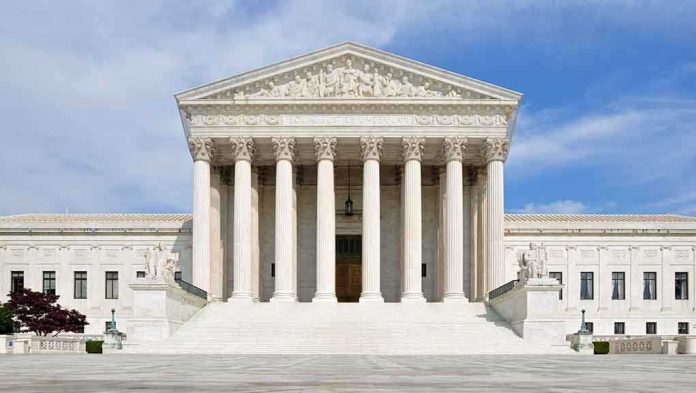
House Republicans moved to lock the Supreme Court at nine justices, advancing a constitutional amendment as Democrats renew calls to expand the bench.
Story Highlights
- House Republicans advanced a constitutional amendment to set the Supreme Court at nine justices.
- Resolution text would fix one chief justice and eight associate justices in the Constitution.
- Democratic leaders previously pushed expansion to 13 seats, keeping court-packing pressure alive.
- Rep. James Clyburn endorsed adding four seats, calling 13 “a pretty good number”.
What The House Did And Why It Matters
House Republican leadership advanced a proposed constitutional amendment to fix the Supreme Court at nine justices. Committee action moved the measure forward, putting it on a path for a House vote in the 119th Congress. The resolution would not change current practice. It would instead lock the existing nine-seat norm into the Constitution to stop future court packing by statute. Backers said the plan protects checks and balances and shields the Court from partisan swings.
House Joint Resolution 1 spells out the number directly. The text states the Supreme Court “shall be composed of nine justices consisting of one chief justice and eight associate justices.” That precision matters. Congress has changed the Court’s size by law in past centuries, but the Constitution does not set a number. Locking the number in the Constitution would close that door for good and require another amendment to change it later.
The Formal Paper Trail Behind The Push
A formal House committee report underscores the seriousness of the effort. House Report 119-732 is titled to propose an amendment requiring nine justices. The report documents the rationale for the cap and records the advancement of the amendment in this Congress. Supporters cite years of Republican proposals to keep the Court at nine and note that earlier efforts set the same standard through identical language, creating a consistent record for the nine-justice rule.
Republicans also point to prior Senate activity that mirrored the House approach. Senators Todd Young and Ted Cruz introduced a constitutional amendment to keep the bench at nine justices. That Senate proposal followed the same logic as the House measure—prevent expansion by baking the current size into the Constitution and removing the temptation to tilt the Court by adding seats. These parallel tracks show a coordinated, bicameral strategy.
Why Now: Court-Packing Pressure From The Left
Democrats and allied activists have argued for expanding the Supreme Court. In 2021, Democratic lawmakers introduced a bill to grow the Court from nine to thirteen justices, billing it as “restoring balance.” That bill showed how quickly a simple statute could reshape the Court’s size, since the Constitution does not set the number. That effort did not pass, but it set a playbook that could return after an election.
Recent remarks renewed that pressure. Representative James Clyburn said Congress should expand the Court to thirteen justices and called thirteen “a pretty good number.” He tied his support to his view of how the Court should handle core constitutional questions. His comments signaled that expansion remains an active goal among party leaders and could reappear if vote margins flip in Congress.
What History Says About Court Size And Stability
American history shows the Court’s size changed several times in the nineteenth century. The number moved between five and ten, often tied to the nation’s growth and circuit structure. Congress finally set the bench at nine under the Judiciary Act of 1869, and it has stayed there ever since. That long, stable run gives weight to the nine-seat norm and helps explain why many Americans see expansion as a threat to the Court’s independence.
🚨 BREAKING: @SpeakerJohnson says the House will vote tomorrow on a proposed constitutional amendment that would permanently limit the Supreme Court to nine justices, making it harder for future administrations or Congresses to expand the bench.
The measure would need a… pic.twitter.com/sMR4RRPaVh
— Just the News (@JustTheNews) September 1, 2026
The modern warning sign remains the failed plan by President Franklin Delano Roosevelt to add justices in 1937. That proposal sought a friendlier Court and met broad resistance as court packing. The size has held at nine after that clash, and legal analysts describe expansion aimed at shifting outcomes as a danger to separation of powers. The House move would elevate that settled practice from a statute to a constitutional rule.
What Comes Next And What It Means For Voters
Passing a constitutional amendment requires two-thirds support in both chambers and ratification by three-fourths of the states. That is a high bar. Even so, the House action sets a clear line for the debate. Republicans argue the amendment guards the rule of law, shields faith in the courts, and blocks a future rush to pack the bench. Voters who value limited government and a stable Constitution now have a concrete measure to watch and weigh.
Sources:
dustyjohnson.house.gov, congress.gov, young.senate.gov, constitutioncenter.org, thehill.com, nbcnews.com