
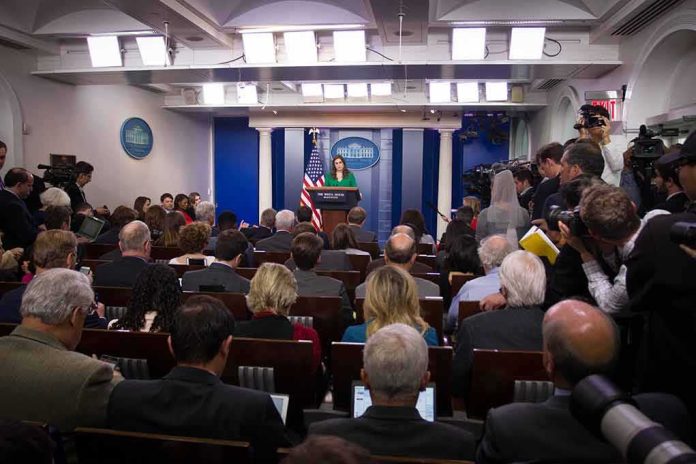
The White House followed through on President Trump’s stated media ban as MS NOW reporters were denied entry to the grounds Saturday morning.
Story Snapshot
- President Trump said he would ban MS NOW, CNN, and Politico from the White House for “fake news.”
- MS NOW says its journalists were blocked from entering the White House the next morning.
- Past court fights show the White House has more control in tight spaces, but not for punishing viewpoints.
- Press passes are physical credentials; revoking them can stop entry at the gate.
Trump’s Ban Statement And Next-Day Denial Reported
President Trump posted Friday that he was banning CNN, MS NOW, and Politico from the White House, citing “constant ‘reporting’ FAKE NEWS!” Major outlets documented the wording and timing of the declaration. The next morning, MS NOW said its journalists were denied access to the White House grounds, describing a real enforcement step after the public warning. The network also signaled it will pursue legal avenues in response to the denial.
Associated Press and United States News and World Report coverage said the denial occurred Saturday morning, making the shift from talk to action clear. The reports did not include a formal revocation letter or a written finding of a credential rule breach specific to MS NOW. That leaves some process questions open, even as the on-the-ground outcome was a blocked entry at the gate for MS NOW staff.
How Press Access Works And Why It Matters
Press access to the White House runs through physical credentials issued with Secret Service security checks. Reporters scan those badges to get onto the grounds. If the White House pulls or suspends those passes, entry stops immediately at the checkpoint. That system makes any broad exclusion possible to carry out. It also makes paper trails important, because written notices and due process can be reviewed in court during First Amendment challenges.
White House access fights are not new, but full outlet bans are rare. The Associated Press sued after its access to smaller venues like the Oval Office and Air Force One was cut back in 2025. A federal trial judge said the cutbacks were likely contrary to the First Amendment. A divided appeals panel later recognized the White House has wider discretion in restricted, small spaces, even as broader press freedoms remain in force. That mixed record shapes today’s dispute.
Free Press Claims And Government Authority In Tension
Sherrill v. Knight, a landmark case, held that once the White House opens press facilities, it cannot deny access based on a journalist’s viewpoint. The case also said any denial should include notice, a chance to respond, and a final written decision. Those principles weigh against viewpoint-based bans tied to “fake news” claims rather than conduct. Advocates argue that punishing coverage invites a First Amendment retaliation case under this framework.
At the same time, courts have allowed more leeway in tight, nonpublic spaces where space is limited and security is strict. That distinction could matter if the dispute is about the Oval Office or Air Force One pools. Saturday’s denial, however, involved access to the grounds, which are used for routine coverage. That broader setting makes viewpoint neutrality and fair process more central, and raises the stakes for how the administration documents and justifies any exclusion.
What Conservatives Should Watch For Next
Conservatives value honest reporting, secure institutions, and equal rules. Many are tired of agenda-driven coverage that smears faith, the flag, or the right to bear arms. The administration says these outlets push false stories. But to stay on firm constitutional ground, the White House should tie any denial to clear, published standards, follow written notice rules, and keep politics out of credential calls. That path enforces order while protecting the First Amendment our founders wrote.
Expect legal action from MS NOW and fierce statements from press groups. Watch for any official credential letters, gate logs, and legal memos that explain who decided what and when. Clear records can show the action followed rules, not feelings. If the fight moves to court, judges will likely ask whether the government used due process and viewpoint-neutral standards, and whether the restriction is limited to small, security-tight spaces or the broader press facilities.
Bottom Line For Readers
Here is what is settled: President Trump announced a ban on CNN, MS NOW, and Politico. MS NOW says its reporters were denied entry the next morning. The government can control access for security and space limits. The Constitution forbids punishing the press for its viewpoints. To uphold both order and liberty, the White House must root any exclusion in clear rules and fair process, not dislike of coverage. That standard protects everyone’s rights, no matter who holds power.
Sources:
mediaite.com, bbc.com, newsday.com, ms.now, ap.org