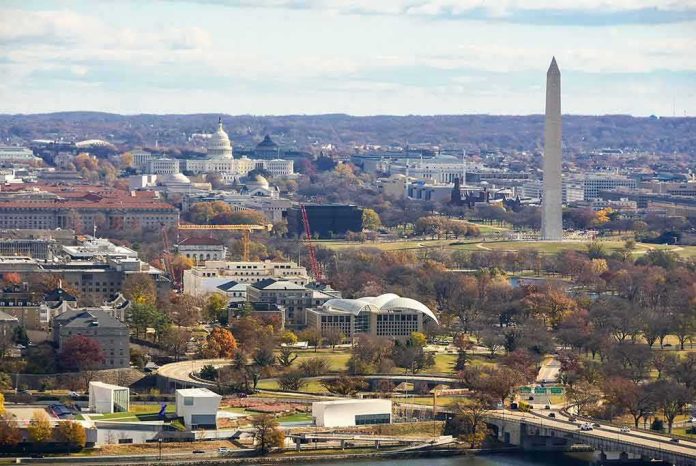
President Trump said the planned 250-foot Triumphal Arch will also function as a “top grade Military Complex,” even as federal reviewers document harms to historic views.
Story Highlights
- Trump touted a dual-use “Military Complex/Triumphal Arch,” citing national security and a military request.
- Federal planning advanced: renderings filed, and a key commission granted preliminary site approval.
- National Park Service found “adverse effects” to dozens of historic sites and views but outlined mitigation steps.
- Veterans sued, arguing the project lacks congressional approval and harms sacred sightlines near Arlington.
What The Administration Announced This Week
President Trump said the Triumphal Arch now carries a dual purpose: a national monument and a “top grade Military Complex.” He framed the shift as a response to national security needs and a request from the United States military. The White House has promoted the arch as a signature civic work since spring. Trump said in April his team “officially filed” plans and renderings with federal design reviewers, calling it the “most beautiful” arch.
The new military label drew fast attention because the public planning record is centered on a commemorative monument. The gathered documents and news reports describe reviews of size, views, traffic, and history compliance. They do not include a named Pentagon sponsor, a defense mission statement, or engineering plans for secure operations. That mismatch has fueled questions about purpose and process across the political spectrum.
Where The Project Stands In The Federal Process
Federal filings and meetings show real movement. The administration submitted renderings to the Commission of Fine Arts and advanced National Park Service planning for a 250-foot arch at Memorial Circle, just across the river from the Lincoln Memorial. The National Capital Planning Commission voted to grant preliminary site and building approval in July. That action kept the project alive while further design and compliance steps continue.
Planning documents described an aggressive build window. Reporting said construction could last two to three years. One document described excavation starting within weeks and year-round work up to 20 hours per day to meet schedule targets. Those timelines created urgency for supporters and a sense of a rush for opponents who want more review before any digging begins.
Why Preservation Officials And Veterans Object
The National Park Service found the arch would cause “adverse effects” to a wide set of historic places and views, including the symbolic axis linking Arlington House, Arlington National Cemetery, and the Lincoln Memorial. The agency proposed mitigation steps such as documenting effects and adding interpretation, but it did not deny the harm. That stance kept the site viable but left critics warning of permanent damage to a civic landscape many consider sacred.
Three Vietnam War veterans and an architectural historian sued earlier this year. They argue the project lacks required congressional authorization and would obstruct honored sightlines near the cemetery and the Lincoln Memorial. They also say the scale and location disrespect the fallen and their families. Their case has become a rally point for those who see the process as stacked toward power, not the public interest.
The New “Military Complex” Claim And What We Can Verify
Trump’s announcement that the arch will double as a military complex is clear and on the record. However, the public documents collected to date focus on a monument, not a secure facility. The materials do not identify a Defense Department customer, force-protection needs, or special security features. That gap makes the claim hard to weigh on technical grounds, even as planning bodies keep reviewing the design as a commemorative work.
Trump says triumphal arch in DC will be converted to ‘top grade military complex’ https://t.co/AvZbYQHlRB via @JustTheNews
— Norman Firebaugh (@FirebaughNorman) September 20, 2026
This clash taps shared public frustrations. Many Americans see a government that moves fast for elite projects yet drags on basics like safety, costs, and transparency. Supporters call the arch a bold symbol of American grit. Opponents call it a rushed vanity build that bends rules and scars hallowed ground. Both sides want clear facts. The next honest step would be releasing any defense mission documents or authorizations that match the “military complex” label.
Sources:
yahoo.com, cnbc.com, washingtonian.com, abcnews.com, politico.com, cnn.com, npr.org, wtop.com