

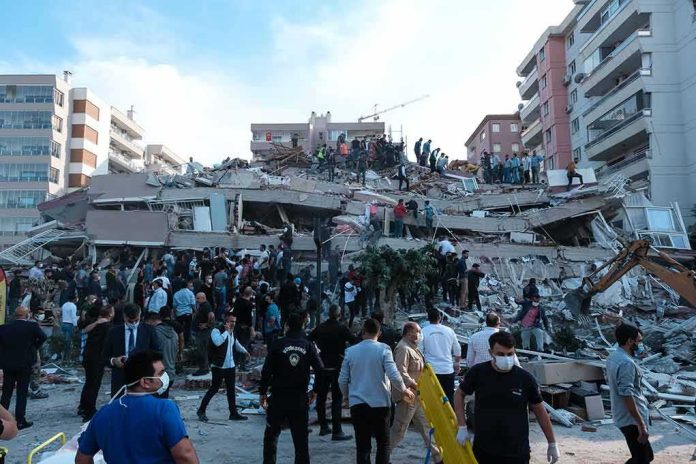
A Brooklyn building crumpled into an adjacent excavation at rush hour, killing multiple people and forcing a massive, hand-by-hand rescue in unstable rubble.
Story Highlights
- Rescuers pulled survivors and victims from a collapsed building near Flatbush and Bedford Avenues.
- About 250 firefighters and emergency medical staff searched the debris with dogs, drones, and hand tools.
- Officials warned that more people could still be in the collapse zone as efforts continued into the night.
- Reports point to an adjacent excavation beside a decades-old structure; the exact cause is still under investigation.
What Happened and When
Witnesses and local outlets reported the collapse shortly after 4 p.m. near Flatbush and Bedford Avenues in Brooklyn. Crews arrived to a large debris field and a partially collapsed structure that had fallen toward a nearby excavation. Reporters at the scene described firefighters crawling over rubble and forming bucket lines to move debris. Television footage showed rescuers removing a survivor around 6:15 p.m., underscoring that this remained an active lifesaving mission, not only a recovery effort.
By early reports, at least two people were removed soon after the collapse, and later counts described more victims located as the search widened. Outlets reported shifting totals as crews worked, with injuries reported in the teens and deaths rising as night fell. The New York City Fire Department leadership told press that they did not know how many people might still be under the rubble, urging patience while teams searched every void space safely.
Scale and Tactics of the Rescue
Local broadcasts reported about 250 New York City Fire Department firefighters and emergency medical staff on scene. New York City Police Department and New York City Fire Department canine teams searched for signs of life. Crews used drones to scan unstable areas from above, while teams on the pile used hand tools, buckets, and vacuum trucks to move debris without causing new collapses. These are standard methods when heavy equipment could endanger trapped people in voids.
Commanders split the site into sectors to manage safety and speed. Firefighters listened for tapping, used cameras to peer into gaps, and paused machinery when dogs alerted. Reporters noted that the work slowed at times due to the risk of secondary collapse. The balance is delicate: move fast to reach survivors but slow enough to prevent more injuries. That is why leaders kept warning that the operation would last through the night and possibly longer.
Why the Numbers Shifted
Breaking events often bring changing counts, and this scene was no exception. Early reports listed one or two dead and a dozen to nearly twenty injured. Later updates raised the death toll sharply. Those swings reflect real-time triage, parallel transports to different hospitals, and the slow pace of confirming identities on a dangerous pile. Outlets updated their stories throughout the evening as officials confirmed more recoveries from the collapse zone.
Some confusion also came from location details. One outlet listed 1321 Flatbush Avenue and another mentioned 1321 Bedford Avenue. Both pointed to the same corner area and the same collapse and rescue scene. That kind of address discrepancy happens when older buildings, corner lots, and adjacent projects share boundaries, but it adds noise during a tense, televised search.
Early Focus of the Investigation
City records and on-scene reporting highlighted an excavation next to a 96-year-old building. Reporters described the structure failing toward that dig site. Engineers will now test whether soil movement, underpinning, or water affected the building’s support, or whether aging masonry and prior wear played a bigger role. In past city cases, both factors sometimes combined. Officials have not released a final cause, and that work will take time.
Search underway a day after deadly Brooklyn building collapse https://t.co/fd34SWAWwM
— Reuters (@Reuters) November 12, 2026
New York City construction data show that excavation and soil work incidents are a regular share of job site risks, even if most do not end in mass-casualty events. City safety reports list recurring categories like excavation, material failure, and worker falls across the boroughs. Those summaries will likely frame the public debate on rules for digging near older buildings and how closely the city watches that work in dense neighborhoods like Flatbush.
Why This Matters Beyond Brooklyn
New Yorkers across the political spectrum share the same core worry shown here: regular people pay the price when oversight, planning, or basic safety break down. Families walked past this site on a normal afternoon. Minutes later, first responders risked their lives in a pile of bricks and dust. Whether the failure ties to construction practices, a weak wall, or both, the lesson is the same. Cities must be ruthless about safety at the edge of old and new.
Readers also care about accountability. That starts with a clear record of call times, rescues, and confirmed identities, and continues with a public explanation of cause. The city’s Department of Buildings will review permits and inspection history. Structural engineers will map the debris and test materials. Those steps do not bring victims back, but they can prevent the next collapse. For now, crews kept digging because people might still be waiting underneath.
Sources:
youtube.com, abcnews.com, cbsnews.com, nbcboston.com, abc7ny.com, nyc.gov