

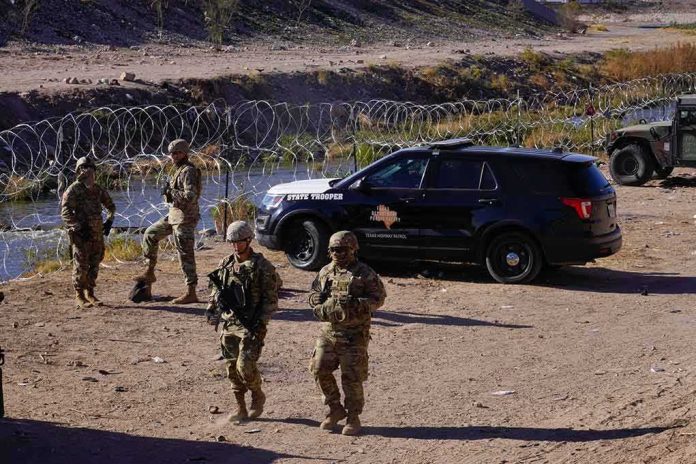
After hundreds of new troops arrived, parts of the Rio Grande fell quiet while officials pointed to more seizures and arrests — but the full cause of the drop remains contested.
Story Snapshot
- The Army expanded its border presence as officials reported a quieter river in Roma, Texas.
- Border Patrol leaders cited more drug seizures, more apprehensions, and less traffic in key spots.
- Crossings had already plunged after 2024 asylum limits and later suspensions, complicating credit.
- CBP still reported large-group apprehensions in the same sector, showing activity continued.
What Changed Along the Rio Grande
Military.com reported that the United States Army boosted personnel to roughly 8,000 along the border, while the Coast Guard and Texas law enforcement increased operations nearby. Reporters on the ground in Roma, Texas, described a quieter river scene after the troop surge. Officials tied the expanded presence to concerns about cartel activity and recent risks to U.S. personnel. Mexico also sent about 500 forces to neighboring Tamaulipas as part of a joint effort against trafficking and smuggling.
U.S. officials said they saw signs of improved security. A Border Patrol deputy chief in the Rio Grande Valley pointed to more drug seizures, higher apprehension counts, and lighter traffic in targeted areas as proof that operations worked. These indicators are common yardsticks for enforcement success. However, the public reporting did not include the underlying totals, time frames, or methods, which makes it hard to judge scale or separate cause from stepped-up patrols.
Why Causation Is Hard to Prove
Analysts and public data linked a major drop in crossings to earlier policy shifts, not only to troops. Crossings fell after the 2024 U.S. asylum restrictions and then dipped again after a later suspension of asylum access along the border, according to reporting on the same Army showcase. That sequence muddies claims that the newer military surge alone produced the quieter river. Multiple experts and outlets have echoed this mixed-cause view in recent years.
The difference between correlation and cause matters here. The reporting does not show a clear before-and-after test tied to the troop timeline, or a comparison with nearby sectors. Weather, season, and Mexico’s actions can all move the numbers. Without a matched baseline and method, the quieter scene may reflect several forces at once. That risk of over-crediting one agency rises when many organizations operate together on the same ground.
On-the-Ground Activity Continues
Customs and Border Protection said Rio Grande Valley agents still faced large groups, even during the period of the Army’s expanded presence. One release reported five groups totaling 648 migrants over five days in Hidalgo and Starr Counties. The Rio Grande City station encountered 520 of those people. These sector updates show that enforcement remained active and that crossings did not stop entirely, even as some river stretches grew calmer.
The Coast Guard also described a serious September 26 incident. Personnel took gunfire from the Mexican side of the river during an operation and returned fire. Military officials cited that clash as one reason to move more troops into the valley. News reports estimated about 500 service members in that specific shift, though the government did not confirm exact counts or say how long they would stay, limiting public clarity on scope and timing.
What Both Sides of the Aisle Should Watch Next
Americans across the political spectrum want results and honest accounting. Clear answers require data. Sector-level daily figures on encounters, rescues, and seizures, paired with deployment logs, could test what the troop surge added beyond policy shifts and Mexican enforcement. That approach would show if troops reduced crossings, improved response times, or shifted routes elsewhere. Until then, the safer read is this: the river looks calmer in spots, but several levers likely pulled the numbers down.
Sources:
military.com, cbp.gov, wola.org