

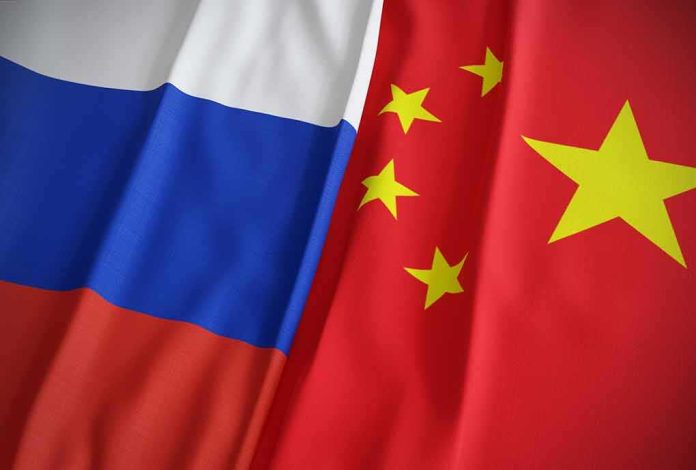
President Trump will sit down with Vladimir Putin and Xi Jinping in China to talk denuclearization, placing America at the table where the world’s most dangerous weapons are discussed.
Story Highlights
- Trump plans a trilateral meeting with Putin and Xi in China during the APEC summit.
- Denuclearization tops the agenda, with Iran and Ukraine also in scope, per public remarks.
- U.S. officials confirmed the meeting plan and set expectations for an initial discussion.
- China’s reluctance on nuclear limits may shape outcomes, but talks are moving forward.
Trump Confirms Leader-Level Talks Focused on Denuclearization
President Trump told reporters he expects to meet President Putin and President Xi in China, with denuclearization as a key topic. He made the remarks ahead of travel and linked the talks to a larger push to reduce nuclear risk and address active conflicts. Reuters recorded the on-camera statement and placed it on November 8, 2026, before his return flight from Florida. Trump also cited Iran and Ukraine as issues that could come up during the broader discussions.
Senior U.S. officials confirmed to ABC News that the first trilateral leader meeting among the United States, China, and Russia is planned on the sidelines of the Asia-Pacific summit. Officials described denuclearization as the main focus and said they expect an initial conversation rather than a signed agreement. That framing sets a clear bar: start the dialogue, reduce risk, and explore next steps without overpromising immediate cuts.
Where and When the Meeting Will Happen
Reporting identified Shenzhen, China, as the venue during the November 18–19 meeting window, with leader-level time slated for November 19. This timeline anchors the diplomatic move in a defined setting rather than a vague idea. Bloomberg and Reuters both described the scheduling and the intent to center the session on denuclearization and related global flashpoints. The United Nations also signaled readiness to support any credible denuclearization effort emerging from the talks.
Diplomatic groundwork preceded the leaders’ session. The U.S. State Department account said Secretary of State Marco Rubio and Chinese Foreign Minister Wang Yi agreed on the value of leader-level talks to advance peace and denuclearization, including a possible trilateral format. That sign of coordination does not lock in outcomes, but it does show officials clearing space for the principals to meet and test ideas face to face.
What Is on the Table: Nukes, Iran, and Ukraine
Trump’s stated agenda extends beyond nuclear risk. He referenced Iran and Ukraine, and outside reporting mentioned North Korea and broader “world peace” themes from China’s public line. A U.S. official suggested Ukraine might not be discussed in the three-way format, pointing to a flexible agenda tailored to what will be most productive in a short leader window. Still, denuclearization remains the headline item that anchors the purpose of the gathering.
Trump-Xi-Putin meeting
China's Foreign Ministry confirmed Xi Jinping will hold a China-Russia-US leaders' meeting with Trump and Putin on Thursday, Nov 19, in Shenzhen, alongside APEC. It is the first such three-way meeting. The White House says Trump will raise nuclear arms…
— Two Reads News (@TwoReadsNews) November 16, 2026
China’s posture could shape how far nuclear talks go. Public reporting says Beijing resists joining hard limits with Washington and Moscow because its arsenal is smaller, and because it prefers not to lock into rules set by larger stockpiles. Reuters also reported Xi was wary of the proposed format. That caution makes a binding deal unlikely in one meeting, but it does not block a leader-level channel for risk reduction and future steps.
Why This Matters to American Security and Wallets
Nuclear risk touches every American family, business, and church. A single misstep abroad can shake markets, spike fuel costs, and stress our troops. When the United States leads talks, we push back on chaos and keep global bullies from setting the rules. This approach aligns with conservative priorities: peace through strength, disciplined diplomacy, and a firm refusal to let foreign powers gamble with our security or drain our economy through endless crises.
Hard results take time in nuclear diplomacy. The first step is getting the right people in the same room and setting a clear aim. Trump’s team has defined that aim as denuclearization and crisis reduction. Officials are not promising a treaty this week, but they are opening a channel with two nuclear powers that impact our energy prices, our supply chains, and our national defense posture. That is how serious talks start, under U.S. leadership.
What to Watch Next
Watch for official readouts from the White House, Beijing, and the Kremlin after the Shenzhen session. Look for whether the parties assign working groups, exchange proposals, or lock in a schedule for follow-on meetings. Those signals show movement from talk to action. Also track whether Iran, Ukraine, or North Korea get specific attention lines, since any progress there can cut risks and costs for Americans at home.
Bottom line: the United States is driving a high-stakes conversation with the two other nuclear heavyweights. The talks are real, scheduled, and aimed at reducing the most dangerous threats on earth. That is a win for American leadership and a step toward a safer world, without writing blank checks or surrendering our sovereignty.
Sources:
youtube.com, reuters.com, bloomberg.com, dw.com