
Pope Leo the Fourteenth told the world on Sunday that doctors found a small growth on his lung, and he will have surgery to remove it.
Story Snapshot
- Pope Leo revealed during his Sunday Angelus address that a nodule was found on his lung during recent medical checks.
- He said doctors called it early-stage and very localized, and he agreed to have it removed by surgery.
- The operation is expected at Rome’s Gemelli Hospital in the coming days, with about a week of recovery.
- The Vatican has not shared the nodule’s size or confirmed whether it is cancerous or not.
What The Pope Told The Crowd In St. Peter’s Square
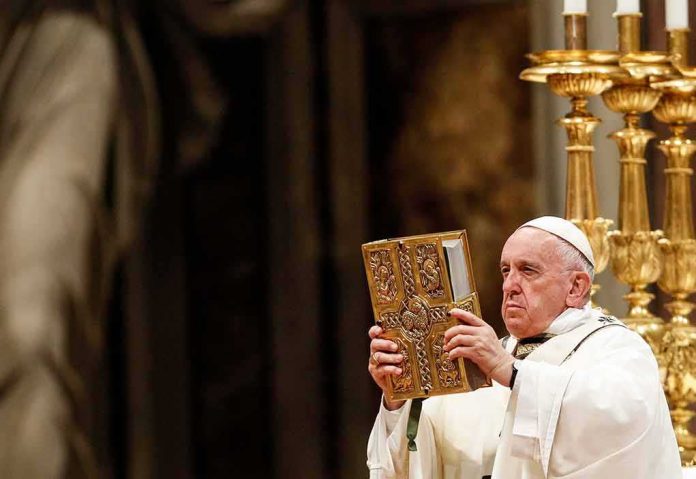
Speaking from his window above St. Peter’s Square, Leo delivered the news himself instead of letting aides announce it. He said, “During recent medical checks, a nodule on my lung was found. It has been detected at a very early stage and is very localized.” He told the crowd his doctors recommended he act, and he agreed to the operation.
The 71-year-old pontiff asked the faithful for their prayers as he prepares for surgery. Vatican News reported the goal of the procedure is simple: cut out the nodule entirely, not just study it further. That detail matters because it signals doctors already have enough information to act, rather than waiting on more tests.
Timing, Location, And What Recovery Looks Like
Holy See Press Office spokesperson Matteo Bruni said the surgery is set for the first days of this week. No exact date has been made public yet. Reports point to Gemelli Hospital in Rome, the same medical center that has treated popes for decades, as the expected site of the operation.
The Vatican press office said Leo should need about one week of hospital recovery after the procedure. That timeline suggests doctors view this as a contained, manageable surgery rather than a drawn-out medical crisis. Still, the Vatican has not released imaging results, lesion measurements, or a pathology finding confirming whether the growth is benign or malignant.
Why Popes Rarely Speak This Openly About Their Own Bodies
For centuries, the Vatican treated a pope’s health as a closely guarded secret, often saying nothing until death was near. That changed with John Paul the Second, who endured very public surgeries and Parkinson’s disease in plain view, and again when Benedict the Sixteenth cited failing health as his reason for resigning in 2013. Leo’s decision to describe his own diagnosis, in his own words, continues that modern shift toward directness.
That openness carries real value for Catholics around the globe who want honesty from their spiritual leader, not filtered statements from handlers. It also reflects basic respect for the public’s intelligence. People can handle plain facts about an elderly man’s lung nodule without panic, and Leo apparently trusts them to do exactly that.
What Happens Next And Why The Silence On Details Isn’t Suspicious
Medical privacy laws and basic decency explain why the Vatican hasn’t released scan results or lab reports. A sitting pope is still a patient, and disclosing size, location, and cell type beyond what he chooses to share would cross a line most Americans would recognize as none of the public’s business. The timeline itself, surgery this week and recovery within roughly seven days, is specific enough to act on.
Pope Leo XIV has announced he will undergo surgery to remove a lung nodule discovered during recent medical examinations.https://t.co/MLW4S5gpUA
— News Central TV (@NewsCentralTV) October 11, 2026
Watch for a Vatican bulletin confirming the surgery happened as planned, followed by word of Leo’s discharge and return to public duties. That update, whenever it comes, will close the loop on this story. Until then, the facts stand as Leo gave them: a small, early, localized nodule, a planned removal, and a pope asking for prayers while he heals.
Sources:
youtube.com, vaticannews.va, abcnews.com