As Vladimir Putin and Xi Jinping put on another choreographed show of “friendship” in Beijing, Americans are reminded why a strong, America‑first White House cannot afford to look away.
Story Snapshot
- Putin receives a lavish Chinese state welcome and joins Xi for a public signing ceremony in Beijing.
- The summit comes just days after President Trump’s visit, underscoring an open contest for influence in China’s backyard.
- Extended Russia‑China “friendship” raises stakes for U.S. security, energy independence, and the dollar’s strength.
- State‑controlled optics from Beijing highlight why America must stay militarily strong and economically sovereign.
Beijing Rolls Out the Red Carpet for Putin Yet Again
Chinese and international coverage confirm that Russian President Vladimir Putin’s latest trip to Beijing is no casual drop‑in; it is a fully staged state visit with every ceremonial bell and whistle. Reports describe Putin arriving to a formal red‑carpet reception at the airport, greeted by senior Chinese officials and treated as a long‑time partner rather than a guest passing through town.[2][3] This visit is being promoted as his twenty‑fifth to China, underscoring how deeply entrenched this partnership has become.[2]
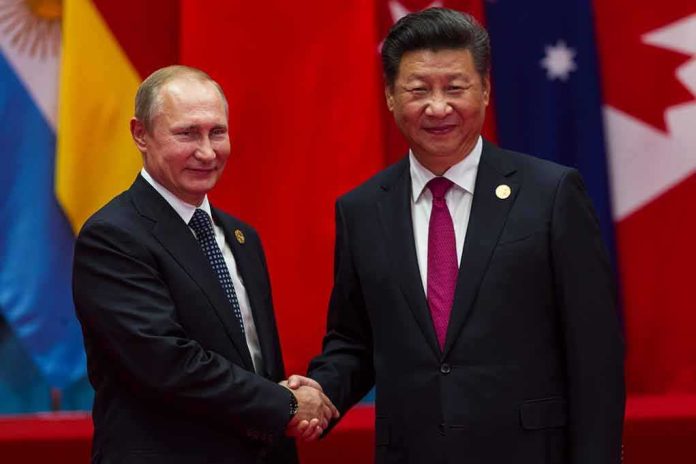
Video from Beijing shows Chinese President Xi Jinping personally hosting a grand welcoming ceremony for Putin outside the Great Hall of the People, complete with military honors and tightly choreographed formations.[4][5] Cameras capture the two leaders standing side by side, reviewing troops and projecting an image of steady, unbroken alignment between Moscow and Beijing.[4][5] For audiences at home in China and Russia, the message is simple: the partnership survives Western pressure and keeps moving forward despite sanctions and ongoing conflict in Europe.
Signing Ceremony Puts Russia‑China “Friendship” on Paper
After the welcome outside the Great Hall, Putin and Xi moved indoors for bilateral talks and a formal signing ceremony that was carried live by multiple outlets.[4][5][7] Descriptions of the event say the leaders oversaw the signature of cooperation documents and then made joint statements to the cameras.[2][7] Chinese state media reported that both sides agreed to extend a friendship treaty originally signed in 2001, signaling that this is not a short‑term tactical alignment, but a long‑running structure both governments are determined to keep.[4]
Coverage notes that the two delegations planned to discuss energy and security alongside broader ties.[4] That almost certainly includes Russian oil and gas flows to China and joint posturing against Western military alliances, even if the exact language of their closed‑door conversations remains off camera. The visual is deliberate: pens signing, flags behind them, handshakes in front of microphones.[7] Beijing uses these images not just to document deals, but to advertise that it can anchor Moscow diplomatically when the West tries to isolate the Kremlin.[2][4]
Summit Timed Just After Trump’s Beijing Trip
One detail American viewers should not ignore is the timing. The South China Morning Post notes that Putin’s visit comes only days after a trip to China by United States President Donald Trump.[2] By scheduling Putin so quickly after a face‑to‑face with Washington, Xi is signaling to the world that Beijing will not be cornered into choosing between America and Russia. Instead, China is trying to leverage both relationships to maximize its own power, playing host to two rival leaders in rapid succession.[2]
For conservatives who remember how prior administrations let Beijing run circles around Washington, this underlines why Trump’s team must stay laser‑focused. A strong America‑first foreign policy has to recognize that China will happily deepen economic and security links with Russia whenever it benefits Chinese interests. That means the United States must defend the dollar, rebuild industrial strength at home, and keep military deterrence credible so hostile blocs cannot use these summits to chip away at American leverage and intimidate allies.
Behind the Choreography: What the Optics Mean for Americans
The Beijing ceremony fits a now familiar pattern where authoritarian governments use spectacle as policy.[1][3][4][5] Every step on the red carpet, every handshake on camera, is staged to convey that Russia and China are shoulder‑to‑shoulder, resisting Western influence and constructing their own rules.[1][4][5] State control over media in both countries allows them to present the summit as a flawless success, without uncomfortable questions about human rights, religious freedom, individual liberty, or the crushing of dissent.
Xi Holds Welcome Ceremony for Putin
Chinese President Xi Jinping held a welcome ceremony for Russian President Vladimir Putin on the morning of May 20 outside the Great Hall of the People in central Beijing.#China #Russia #Xijinping #ChinesePresident #Putin… pic.twitter.com/MZvwspsrpY
— CCTV+ (@CCTV_Plus) May 20, 2026
For American readers, the takeaway is not panic, but clarity. These are not friends of the United States Constitution or of free markets governed by the rule of law. They prefer centralized power, soft censorship, and economic systems that serve the state first. When they shake hands under giant flags in Beijing, they are betting that a divided, distracted America will ease pressure on them. A united conservative movement at home—backing secure borders, energy independence, fiscal discipline, and a strong military—remains the best answer to their carefully staged shows.
Sources:
[1] YouTube – FULL CEREMONY: Red Carpet For Friend! Vladimir Putin …
[2] Web – Russian leader Vladimir Putin arrives in China just days …
[3] YouTube – Putin Receives Full State Welcome Upon Arrival in Beijing
[4] YouTube – China’s Xi holds welcome ceremony for Russia’s Putin in …
[5] YouTube – Xi Jinping hosts a welcome ceremony for Putin in China (full)
[7] YouTube – LIVE: Putin and Xi speak at signing ceremony in China