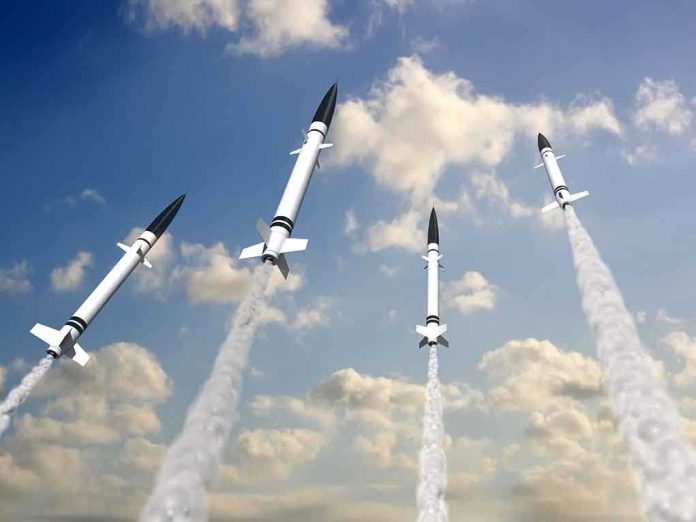
China fields the world’s largest hypersonic missile arsenal, with up to 600 weapons primed to sink U.S. carrier strike groups in hours—what does this mean for America’s naval supremacy?
Story Snapshot
- Pentagon study reveals China possesses ~600 operational hypersonic missiles, outpacing all rivals.
- DF-17, DF-21D, and DF-26 target U.S. carriers and Pacific bases in saturation attacks.
- PLA aims to cripple U.S. power projection in the Western Pacific’s First and Second Island Chains.
- U.S. Navy shifts posture due to vulnerabilities in defenses and logistics.
- China’s missile edge forces America to rethink carrier-centric strategy rooted in deterrence and strength.
Pentagon Study Quantifies China’s Hypersonic Lead
PLA Rocket Force deploys up to 600 hypersonic missiles, including DF-17 with maneuverable glide vehicles, DF-21D anti-ship ballistic missiles, and DF-26 intermediate-range systems. These weapons achieve Mach 5+ speeds and evade traditional defenses through terminal-phase maneuvers. Pentagon analysts label this inventory the world’s largest, far exceeding U.S. or Russian operational numbers. China prioritizes these for anti-access/area-denial, directly challenging U.S. naval dominance since the 1995-96 Taiwan Strait crisis.
Production scaled rapidly from the mid-2010s, with multiple brigades now operational. This buildup integrates with conventional ballistic and cruise missiles for mass salvos. Facts align with conservative priorities: robust deterrence demands matching such threats, not wishful thinking about diplomacy alone.
PLA Operational Concepts Target Carriers and Bases
China plans multi-axis saturation strikes to overwhelm U.S. carrier defenses. DF-21D and DF-26 track moving ships via PLA Strategic Support Force intelligence, surveillance, and reconnaissance. Initial waves crater runways at Guam, Kadena, and Yokosuka, followed by anti-ship barrages. This sequence erodes U.S. command nodes and logistics in conflict’s first hours. Carriers inside the First Island Chain face mission-kill risks from coordinated PLA Navy and Rocket Force assets.
DF-17 hypersonic glide vehicles enhance precision against hardened targets. Pentagon study details how these exploit U.S. interceptor limits—finite Aegis and THAAD stocks cannot counter hundreds of incoming threats. Common sense dictates dispersing forces; centralized carriers invite affordable missiles to counter billion-dollar hulls, inverting cost asymmetry against America.
Historical Buildup Traces to Taiwan Tensions
PLA missile modernization accelerated post-1996, when U.S. carriers deterred Chinese actions near Taiwan. Early 2000s saw conventional ballistic expansions; late 2000s introduced DF-21D as the first anti-ship ballistic missile. Mid-2010s brought DF-26 and DF-17, tested for Pacific ranges. By 2020-2023, assessments confirmed hundreds deployed, integrated with cyber and space support for real-time targeting.
This evolution embodies “system destruction warfare,” paralyzing U.S. operations rather than platform attrition. U.S. reports from 2020 onward warned of base vulnerabilities, shrinking response windows. Conservative values affirm strength through readiness—China’s progress exposes delays in American production and basing reforms.
U.S. Response Reshapes Pacific Posture
U.S. Indo-Pacific Command adopts distributed operations and expeditionary bases to survive salvos. Navy plans expand long-range anti-ship missiles from 2,500 to 15,000 by 2035. Allies like Japan harden facilities amid shared risks. Yet, carrier groups remain primary targets, prompting debates on operating beyond Second Island Chain ranges.
Experts note U.S. edges in undersea warfare and alliances persist, but missile numerical superiority grants China first-strike leverage. Facts support urgency: without matching inventories and defenses, deterrence weakens, risking escalation over Taiwan or South China Sea. America must prioritize industrial base revival for credible power projection.
Sources:
https://militarywatchmagazine.com/article/china-top-five-carrier-killer-ballistic-missiles
https://militarywatchmagazine.com/article/world-largest-hypersonic-arsenal-pentagon-china