
As Colorado wildfires explode across the western mountains, three dead firefighters and rushing evacuations are forcing hard questions about how a government run by elites keeps failing people on the front lines.
Story Snapshot
- Three federal wildland firefighters were killed in the Snyder Fire, showing how extreme and fast these new fires have become.[1]
- The Snyder Fire alone has burned about 28,000 acres with zero containment, while other fires are driving evacuations across western Colorado.[1]
- Governor Jared Polis has declared emergencies and called in the National Guard, yet many residents still feel unprotected and unheard.[1]
- Decades of growth in huge Colorado fires now collide with strained budgets, confused evacuations, and a deep lack of trust in federal and state institutions.[11]
Firefighters’ deaths show growing danger on the front lines
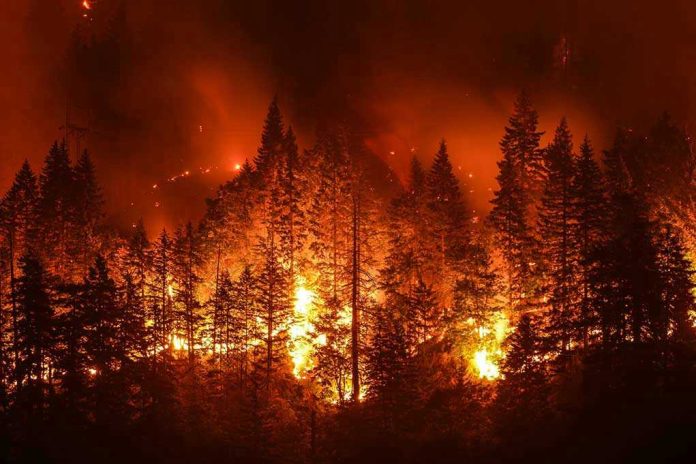
Three federal wildland firefighters were killed and two injured when the Snyder Fire overran their position near the Colorado–Utah border. The burnover happened late June 27, as flames from several lightning-sparked fires merged into one fast-moving blaze. Officials say the Snyder Fire has burned over 28,000 acres and remains at zero percent containment, making it one of the deadliest wildfire incidents for firefighters in the West this year. Their deaths highlight how dangerous these fires have become for those sworn to protect the public.[1][2]
The firefighters were part of a federal crew attacking the Knowles Fire, which then became part of the larger Snyder Fire complex. A Department of the Interior release says they were on the Rifle Helitack crew, flying and hiking into rough terrain to hit new fires before they grew. That kind of initial attack work is supposed to stop small blazes from becoming disasters, yet this time the fire outpaced plans and training. For many Americans, stories like this reinforce a fear that the system is stretched too thin and the risks are pushed onto working people, not the decision makers.[6]
Exploding fires and rushed evacuations across western Colorado
The Snyder Fire is only one of several large fires forcing evacuations in Colorado’s mountain counties. Local reports describe mandatory evacuation orders near Turquoise Lake because of the Willow Fire, along with pre-evacuation alerts between Peck’s Trailer Park and a cemetery near the Gold Mountain Fire. North of Dolores, the Ferris Fire has grown into a single blaze over 10,000 to 16,000 acres, closing roads and pushing people from their homes. The exact acreage keeps changing, but the pattern is clear: multiple fires are spreading fast while communities scramble to get out of the way.[2][3]
The National Weather Service issued a “particularly dangerous situation” fire warning, its highest level, due to strong winds up to about 40 miles per hour and very low humidity. Those winds can turn a small fire into a wall of flames in hours, jumping roads and surprising both residents and crews. In Mesa County, more than 100 campers near the town of Mack were evacuated as the Snyder Fire expanded, and an evacuation center was opened and later moved as smoke and fire threats shifted. People watching this unfold see yet another crisis where ordinary families must move fast while officials struggle to keep up.[1][2]
Emergency declarations and the limits of government response
Colorado Governor Jared Polis declared a disaster emergency for the Snyder Fire and related blazes, activating the state emergency operations center and authorizing the Colorado National Guard to help. The order covers fires like Snyder, Gold Mountain, and Ferris, and is meant to speed up air support, road closures, and relief services. On paper, this looks like a strong response. In practice, residents often meet roadblocks, mixed messages, and slow aid, adding to the feeling that government mobilizes faster to manage public image than to protect lives.[1]
The Bureau of Land Management’s Grand Junction office closed public lands in the McInnis Canyons National Conservation Area as fire danger spiked. Mesa County health officials urged people to stay inside during heavy smoke and to wear N95 masks when outside. These steps mirror the playbook many remember from the pandemic era: warnings, restrictions, and emergency rules that often fall hardest on regular people while larger forces, like long-term forest policy and energy decisions, remain unchanged. Both conservatives and liberals may see these fires as another sign that leaders react to symptoms but rarely fix root problems.[1]
Decades of bigger fires collide with public mistrust
Research on Colorado wildfire trends shows this year’s crisis is part of a long rise in large, intense fires. Since 1990, wildfires in the state have grown more frequent and larger, with a small number of huge fires causing nearly half of all acres burned. Eight of the ten biggest fires in Colorado history have happened since 2012, including three in 2020 alone. Scientists link this to long droughts, dead trees, and a changing climate that dries out forests and grasslands. These numbers back up the official warnings about “rapidly expanding” fires and the need for evacuations.[11][13]
At the same time, many people no longer trust the institutions sharing that data. Federal agencies and state governments control the official story on firefighter deaths, fire size, and evacuation zones. When names are held back or maps are vague, skeptics ask if something is being hidden, even when the delays aim to protect families. Social media then floods feeds with dramatic videos of flames and aircraft, often drowning out careful details. That rush of emotional content can make it hard to separate real risk from hype, yet the danger to firefighters and residents is not in doubt.[1][2][6]
Shared frustrations and what these fires reveal about the system
For many conservatives, these fires seem tied to years of federal mismanagement, green mandates, and spending that did not fix the forests on the ground. They see crews dying in the field while money flows to distant programs and “experts.” For many liberals, the same events highlight climate change, growing gaps between rich and poor, and weak safety nets for families forced to evacuate on short notice. Both sides increasingly agree on one point: the system is failing the people it is supposed to protect.
When three firefighters die in a single burnover and thousands of acres go up in smoke, it exposes how much depends on workers who face the flames while decisions are made far away. Wildfires like Snyder show that nature does not care about talking points or party lines. Yet each new disaster lands in a country where trust in government is already low. As western Colorado watches the skies turn orange and families pack their cars, the deeper question is whether leaders will use this tragedy to change how they plan, spend, and tell the truth—or whether this will become just another chapter in a long list of preventable crises.[1]
Sources:
[1] YouTube – Colorado wildfires explode as winds drive evacuations
[2] Web – 3 firefighters killed, 2 injured responding to Snyder wildfire on Utah …
[3] Web – 3 firefighters killed on Colorado-Utah border as wildfires intensify
[6] Web – A firefighter from Warrior was killed Saturday while responding to the …
[11] Web – Sharpe Fire is burning thousands of acres at the Colorado border …
[13] YouTube – Latest headlines | Wildfires prompt evacuations in Colorado