
On a busy Saturday afternoon in Idaho, a simple burger run turned into a deadly reminder that everyday Americans can be gunned down anywhere, while leaders in Washington argue and the system struggles to keep them safe.
Story Snapshot
- Three people were killed and at least two others injured in a shooting at or near an In-N-Out Burger in Twin Falls, Idaho.
- Police called it an active shooter incident, locked down nearby roads and businesses, and later confirmed the suspected gunman is dead.
- Officials are still working to confirm the exact number of victims, identify the shooter, and understand what led to the attack.
- The chaos, confusion, and reliance on official statements highlight how ordinary people feel exposed while institutions sort out the details.
What Happened At The Twin Falls In-N-Out
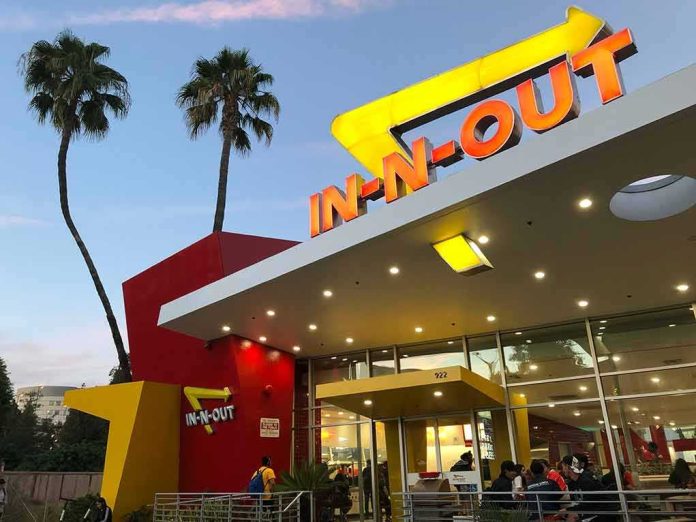
On Saturday afternoon, police in Twin Falls, Idaho, rushed to reports of gunfire at an In-N-Out Burger on Blue Lakes Boulevard, a location that had opened only days earlier and was packed with customers. City and police spokespeople said a shooting at or around the restaurant left at least three people dead and at least two more injured, turning a normal weekend into a scene of panic. Officers from local and state agencies, along with paramedics, flooded the area and blocked nearby roads as they tried to secure the scene.
Twin Falls Police Chief Matthew Hicks described the event as an active shooter incident and confirmed that there were fatalities and injuries, even as he held back exact numbers until families could be told. He said officers first responded to reports of shots fired at the restaurant and quickly found a large, chaotic crime scene with many people fleeing or in shock. Hundreds of people were in or near the restaurant and nearby businesses when the shooting began, so investigators now face a long task of interviewing witnesses and reviewing video.
Casualties, Suspect Status, And Ongoing Questions
Local outlets and national networks reported that at least three people were killed and two wounded, with the injured taken to Saint Luke’s hospital for treatment. Some early reports mentioned more people hurt, which later narrowed as officials updated the numbers, a common pattern in fast-moving violent events where hospitals and police are still counting. Chief Hicks and city spokesperson Josh Palmer both said that while the toll was serious, the exact total was still being confirmed and could shift as the investigation continues.
One of the most important details for frightened residents is whether the threat is over. Police officials said the suspected shooter is dead and that they believe there is no ongoing danger to the community. Investigators think there was one attacker, but they are still working to identify him and to determine whether anyone else helped or planned the attack. Hicks explained that the suspect died near the scene, and officers are now focused on learning his motives and background, a process that often takes days or longer. This gap between a deadly act and clear answers fuels public distrust and feeds the sense that ordinary people are left in the dark.
How The Community Experienced The Attack
Witness accounts show how suddenly public life can turn violent. One driver told reporters he was stopped at a traffic light near the In-N-Out when he saw a person with an AR-style rifle step out of the drive-through lane before gunfire broke out. He saw an employee drag a woman with a gunshot wound to safety and wait with her for paramedics, a small act of courage in the middle of fear. Other videos shared online appear to show a man firing toward cars in a busy parking lot, as people run and vehicles try to escape. For many locals, these images are now linked to a place that was supposed to be simple and fun.
The emergency response was large and intense. Twin Falls Police, the Twin Falls County Sheriff’s Office, Idaho State Police, and the Federal Bureau of Investigation (FBI) all responded or assisted, underlining how serious the incident was. Roads around the restaurant and the Perrine Bridge were closed to traffic, nearby shops went into lockdown, and residents were urged to avoid the area so first responders could work. Even Saint Luke’s hospital asked people to stay away unless they faced a true emergency, because staff were dealing with victims from the shooting. For people in Twin Falls, this looked less like a small-town crime and more like the scenes they are used to seeing from big cities on national news.
Why This Shooting Feels Bigger Than One Crime Scene
Many Americans, both conservative and liberal, look at events like this and see more than one tragic day. They see a pattern where deadly violence keeps breaking out in normal places—restaurants, shopping areas, schools—while the federal government seems locked in endless fights that rarely fix anything. This In-N-Out attack came at a time when people across the political spectrum already feel that those in charge, from Washington to state capitals, are not listening to their daily worries about safety, cost of living, and basic fairness.
At this time, numerous emergency crews are responding to an active shooter at an In-N-Out Burger restaurant in Twin Falls, Idaho, where multiple people have reportedly been injured. According to authorities, they are looking for possibly two suspects involved in the shooting …
— SANJEEV CHAUHAN (@SanjeevCrime) August 2, 2026
For conservatives who worry about crime, lax enforcement, and a culture that ignores personal responsibility, a shooting in a family fast-food spot reinforces the belief that leaders focus more on talking points than on protecting communities. For liberals who worry about growing inequality, mental health gaps, and easy access to deadly weapons, the same event proves that deep social problems keep getting pushed aside. Both sides can agree on one thing here: ordinary people were caught in gunfire while the systems meant to protect them once again reacted after the fact.
Broken Trust And The Search For Straight Answers
The way information came out after the shooting also feeds distrust. Early reports differed on the exact number of victims and on whether the suspect was still at large, and some details came first from social media videos instead of official records. Police and city leaders had to balance speed and accuracy, promising transparency while also holding back names and numbers until they were sure, which is standard but frustrating for worried families and neighbors. As investigators now review surveillance footage, ballistics evidence, and witness interviews, people in Twin Falls are left waiting for a clear story of what happened and why.
This waiting period matters beyond Idaho. Many Americans already feel that powerful institutions—from federal agencies to big news outlets—decide what to share and when, and that ordinary citizens only get fragments. A deadly attack at a simple burger restaurant, followed by partial updates and shifting counts, fits too neatly into that larger story of a system that reacts more than it prevents, explains slowly, and rarely seems to learn. That shared frustration, across right and left, is the backdrop to this tragedy and to the questions that will follow it.
Sources:
independent.co.uk, youtube.com, cbsnews.com, gbnews.com, facebook.com, apnews.com, x.com, instagram.com