The fight over where 5,000 Marines sleep tonight could decide how fast America can move if China makes a run at Taiwan.
Story Snapshot
- Experts argue Okinawa-based Marines provide the quickest U.S. response option in a Taiwan or East China Sea crisis.
- A long-standing U.S.-Japan plan to shift thousands of Marines to Guam now collides with new Marine Corps “Force Design” realities.
- Japan has poured major funding into Guam facilities, yet the Marine Corps signals the move will stay “situation-dependent.”
- Keeping forces on Okinawa strengthens deterrence but keeps Okinawans living with the densest U.S. basing burden in Japan.
Okinawa’s proximity is the whole point, and everyone knows it
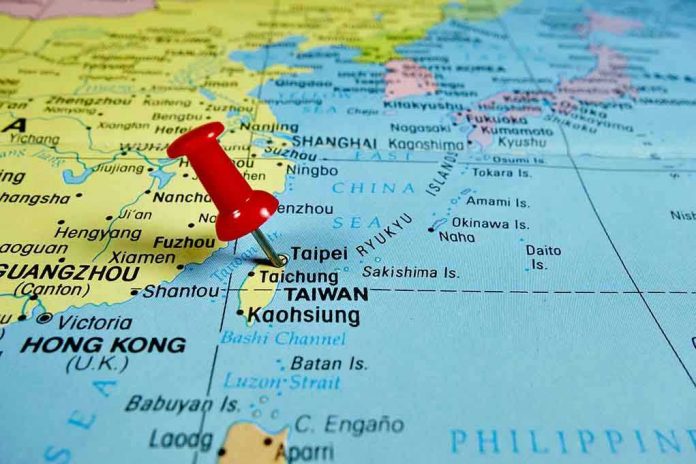
Okinawa is not just another overseas posting; it is geography with a uniform on. The island chain sits near the routes any Chinese operation around Taiwan would have to respect, and it places U.S. forces close enough to matter quickly. Atlantic Council analysts warn that moving roughly 5,000 Marines to Guam trades speed for distance at the exact moment deterrence relies on speed. Their premise is blunt: a closer force complicates China’s planning.
Distance sounds abstract until you translate it into hours, fuel, and missiles. Guam offers more space and arguably less local friction, but it also sits farther from the flashpoints that have dominated Indo-Pacific planning: Taiwan, the East China Sea, and the first island chain. Marine Corps Commandant Gen. Eric Smith has questioned whether Guam’s distance fits the threats. Conservatives tend to prefer capabilities that work on Day One, not capabilities that look tidy on a spreadsheet.
A 20-year relocation promise meets a new era of hard choices
The relocation plan grew out of a real political and moral problem: Okinawa hosts a large share of U.S. forces in Japan despite being a small fraction of Japan’s land. Accidents, noise, and crime created grievances that hardened into a long-running demand to reduce the “base burden.” The Defense Policy Review Initiative, formalized in 2006, aimed to shift about 9,000 Marines off Okinawa, including roughly 5,000 to Guam, with Japan helping fund the infrastructure.
Plans rarely survive contact with a changing world. By 2012, the relocation of Marine Corps Air Station Futenma within Okinawa became decoupled from troop reductions, leaving around 10,000 Marines still on the islands. Construction tied to the Futenma replacement at Henoko has dragged on amid protests and court fights, keeping the local argument alive: Washington and Tokyo promise change, then extend timelines. That trust deficit now shadows every new adjustment to force posture.
Force Design shifts the Marine Corps from “presence” to “usefulness”
Marine Corps “Force Design” reforms, including a 2025 update, reshaped what units the Corps wants forward and why. The point is not ceremonial presence; the point is survivable, mobile forces that can sense, strike, and persist inside an adversary’s weapons envelope. That logic makes Okinawa feel more valuable, not less, because it supports stand-in forces and rapid response. Reports indicate the Corps chose to retain key elements in Okinawa rather than complete a full transfer.
The Marine Corps also has to manage a reality voters understand: deterrence is not charity. Japan’s government has funded facilities for the Guam move, and by 2026 significant spending had already occurred. When the U.S. signals it might not fully use what Japan paid for, Tokyo faces domestic questions, and Okinawa faces renewed skepticism that any burden reduction will ever arrive. Alliance credibility depends on keeping commitments or renegotiating them honestly, not drifting into ambiguity.
Deterrence versus burden: a dilemma with no clean moral victory
Atlantic Council authors make a strategic case for keeping the Marines in Okinawa: the closer the force, the harder it is for China to gamble on a quick fait accompli against Taiwan. They even propose pairing military retention with practical steps aimed at local acceptance, including economic incentives to communities that host bases. That approach aligns with common sense: if national security requires a community to carry a heavier load, the nation should pay transparently, not pretend the load is weightless.
Okinawans still have legitimate grievances. Concentrating bases in a dense area magnifies every incident and every aircraft noise complaint, and the long Futenma-to-Henoko saga has become a symbol of government decisions made far away. Conservative values don’t require ignoring local impacts; they require prioritizing national defense while addressing harms directly, enforcing discipline, and compensating communities fairly. The weakest argument is one that treats Okinawa as simply “someone else’s problem” until the next crisis.
What happens next: a phased move, a political clock, and China watching
The current posture looks like a partial, phased shift rather than a clean departure. About 100 logistics Marines have moved to Guam as an initial step, and official statements emphasize flexibility and “operational needs.” That language may be true, but it also signals a classic bureaucratic escape hatch: no firm endpoint and no crisp promise to either Okinawa residents or Japanese taxpayers. China benefits from hesitation because hesitation invites miscalculation.
Practical policy should start with a hard question: what basing arrangement gives the U.S. the fastest credible combat power in the first week of a Taiwan contingency while still reducing avoidable friction with Okinawans? Keeping key combat elements close while relocating some support functions might satisfy both readiness and burden reduction, but only if leaders state the plan plainly and fund it fully. Deterrence fails when allies argue about logistics while an adversary counts launchers.
Experts warn moving Marines away from Okinawa would play into China’s hands https://t.co/LRJBDtzbv1
— Jeff_Schogol (@JSchogol73030) February 9, 2026
Washington also has to remember what voters at home expect: defense dollars should buy readiness, not performative reshuffling. If the Marine Corps assesses that Guam is too distant for the missions Americans care about, leaders should renegotiate the old framework with Japan rather than drag it out. If Okinawa remains essential, then discipline, transparency, and compensation must rise to meet that reality. The strategic map has changed; pretending it hasn’t is the real giveaway.
Sources:
Trump Taps New Marine Commander for Key US Force in Japan
Japan Press report on USMC policy shift regarding Okinawa-to-Guam relocation
Okinawa-Guam Marines relocation coverage
Relocation of Marine Corps Air Station Futenma
Experts warn moving Marines away from Okinawa would play into China’s hands
USMC/MOD joint statement: commencement of force flow
The Marine Corps’ presence in Okinawa is critical to deterring China and North Korea