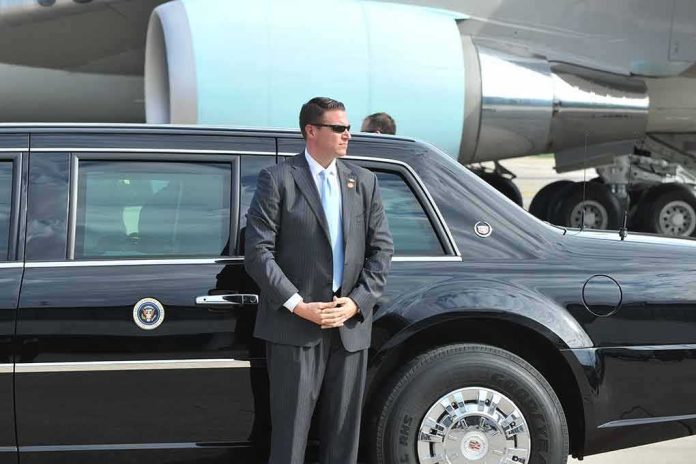
Homeland Security Secretary Markwayne Mullin’s government jet lost an engine mid-flight Wednesday and landed safely at Reagan National Airport, with all 14 people aboard walking away unharmed.
Story Snapshot
- Mullin’s Coast Guard aircraft declared an in-flight emergency after its right engine failed.
- The jet landed safely at Ronald Reagan Washington National Airport around 1:35 p.m.
- All 14 people aboard, including the secretary, were uninjured.
- Mullin publicly thanked the Coast Guard pilots for making the single-engine landing “feel routine.”
Engine Failure Forces Emergency Call
The pilot of the aircraft radioed air traffic control to declare an emergency, saying, “We just lost our right engine and would like to declare an emergency and immediate landing at DCA.” Reuters reported the pilot “declared an emergency after the right engine failed”. The crew also told controllers they had about two and a half hours of fuel remaining as they worked out a plan for the landing.
The plane was carrying Mullin and 13 other people when the engine trouble started. Multiple outlets, including Politico and ABC News, confirmed the total headcount at 14, matching what the crew relayed to air traffic control during the emergency call.
Safe Landing at Reagan National
The aircraft touched down safely at Reagan National Airport on Wednesday afternoon. Reuters reported the jet “safely diverted to Reagan Washington National Airport,” and Politico described the landing as an emergency touchdown that ended without incident. No injuries were reported among anyone on board.
News outlets identified the plane as a Coast Guard-operated Gulfstream V, also referred to as a C-37A jet. Reuters called it a “U.S. Coast Guard-operated Gulfstream V jet,” while other reports described it simply as a Coast Guard jet assigned to carry the secretary. Some reporting has noted the aircraft is around 25 years old and had reportedly been flagged in 2025 as due for replacement.
Secretary Praises Crew’s Handling
Mullin took to social media after landing to credit the flight crew for keeping the situation calm. “The United States Coast Guard pilots made the single engine landing feel routine. No panic, just straight professionalism,” he wrote. His statement offered the clearest first-hand account of how the emergency played out from someone who was on board.
A plane carrying DHS Secretary Markwayne Mullin was diverted to a Washington, D.C., area airport after it declared an emergency. https://t.co/2tDG2HktJE
— USA TODAY (@USATODAY) September 3, 2026
News accounts differ slightly on how to describe the mechanical problem. Some reports say the engine simply failed, while at least one account says it caught fire after failing. That difference has not been resolved by any public maintenance record or safety report so far.
Why Engine Emergencies Get Close Scrutiny
Federal rules require operators to notify safety investigators quickly when certain engine failures happen in flight, treating them as reportable events rather than routine mechanical hiccups. That standard exists because investigators have found, case after case, that the real question is not whether an engine fails, but whether the crew keeps control and the failure stays contained. In this case, the crew clearly did both, landing the plane without harm to anyone aboard.
Sources:
youtube.com, politico.com, washingtonpost.com, reuters.com, x.com