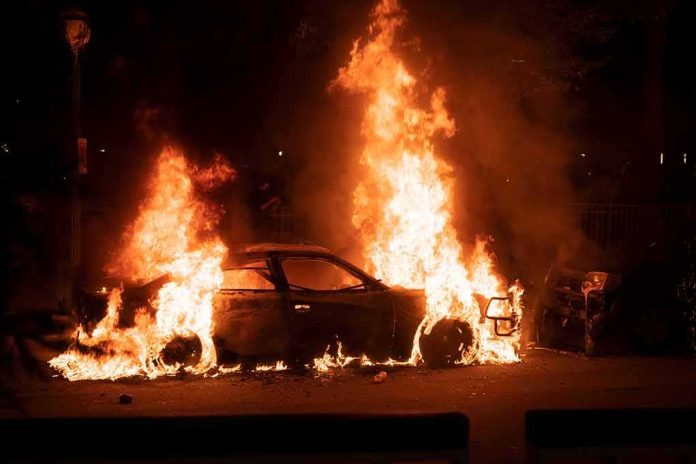
The same fireworks that light up our skies are now blowing up cars, hotel lots, and families’ lives.
Story Snapshot
- Illegal fireworks turned July 4, 2026 into a deadly weekend in California and beyond.
- A young woman in Chino and an eight-year-old girl in Orange County died in separate blasts.
- Police and prosecutors are charging local hosts with manslaughter, not calling these “accidents.”
- National injury numbers show this is part of a growing and very predictable July 4 danger.
How a holiday street gathering in Chino became a deadly blast zone
Chino should have had the usual Fourth of July scene: a quiet neighborhood, kids running around, families near parked cars. Instead, around 8:30 p.m., a vehicle on D Street exploded after what police believe was a large stash of fireworks ignited, killing a woman in her twenties and injuring three others, including a child. Officers found two vehicles engulfed in flames and victims with severe trauma. Detectives say commercial-grade fireworks were at the scene, far beyond backyard sparkler territory.
Police detained 28-year-old Derion Tradon James Jr., a Hesperia resident, and booked him on suspicion of involuntary manslaughter. That charge signals how investigators see the case: not as bad luck, but as deadly negligence. The exact ignition trigger is still under review, but the core facts are solid. A large quantity of powerful fireworks in a residential setting turned one parked car into a bomb, and a young woman paid with her life.
The Orange County girl who went to a party and never came home
One year earlier in Buena Park, Orange County, eight-year-old Jasmine stood with family and neighbors, watching what was supposed to be a fun unofficial show. The main device was a “cake” – a box that shoots multiple fireballs into the air, the kind many people see as harmless party entertainment. It malfunctioned, sending fireballs horizontally into the crowd. One struck Jasmine, causing injuries that prosecutors say led to her death.
Orange County prosecutors later charged 47-year-old Earl De Castro with involuntary manslaughter and with illegally possessing more than 100 pounds of dangerous fireworks. That is not a few leftover Roman candles in a garage. It is the kind of stockpile you would expect from a small vendor or show operator. Prosecutors argue this was not a freak mishap but the foreseeable result of running a large illegal display in a residential area. Jasmine’s mother, in deep grief, said she did not want charges and felt it was an accident, but the state did not agree.
Wilmington motel parking lot: a car fire, a blast, and a man fighting for his life
In Wilmington, along Pacific Coast Highway in Los Angeles, a motel parking lot became the setting for another violent fireworks-linked explosion. Behind the Crescent Inn, illegal fireworks ignited a car, triggering a blast and a fire that left a man critically injured with severe trauma, according to Los Angeles Fire Department officials. Video from the scene shows a burned-out vehicle and scorched asphalt, the kind of damage more often seen after a gas explosion than a “party favor.”
Investigators suspect smoking in the car may have played a role, but the exact ignition chain is not confirmed. What is confirmed is that illegal fireworks were present and that one man now faces a long recovery, if he survives. For American conservative values rooted in responsibility and order, the picture is clear enough: mixing powerful explosives, crowded motels, and casual behavior is a recipe for chaos that burdens families, first responders, and taxpayers.
When fireworks jump the fence: planes, bridges, and busy cities
The problem did not stop at California’s borders. A firework struck Delta Flight 1076 as it landed at Midway International Airport in Chicago during Fourth of July celebrations, prompting a federal investigation. On the East Coast, a fireworks show sparked a small fire on the Brooklyn Bridge, one of the nation’s busiest landmarks, forcing crews to respond on a night when they were already stretched thin. Neither incident caused mass casualties, but both show how far these “celebrations” can reach.
These events highlight a larger question of common sense. Lighting explosives near planes, bridges, or dense city streets is not free expression. It is reckless behavior that puts strangers at risk without their consent. That clashes with a core conservative idea: your freedom ends where your neighbor’s safety begins. When fireworks cross those lines, regulation is not overreach; it is basic protection.
The bigger pattern: July 4 injuries keep climbing, and illegal devices punch above their weight
National numbers confirm that these 2026 blasts fit a wider pattern. The United States Consumer Product Safety Commission reports a major jump in fireworks injuries, from about 9,700 emergency room cases in one year to about 14,700 the next, a rise of more than 50 percent. At least 11 non-work fireworks deaths were recorded in 2024, and some independent reviews suggest the real toll was even higher when all news reports and medical examiner records were counted.
I live in a beach neighborhood where people go nuts setting off illegal fireworks on the beach. The biggest night here is 7/3. The unrelenting explosions begin at sunset and last until midnight. Headphones for humans and medications for pets help. Wildlife goes into hiding.
— Kate Hannon (@katehannonma) July 6, 2026
Data show that illegal and homemade fireworks now account for a growing share of injuries, climbing from about 5 percent to 14 percent in just one year. These devices are a small part of total use but cause a big share of the worst outcomes. That matches what Californians saw in Chino, Buena Park, and Wilmington: not one-off bad luck, but a predictable result when powerful fireworks are stored in cars, blasted near kids, or set off in tight urban spaces. For anyone who values law, order, and protecting families, calling this “just tradition” no longer holds up.
Sources:
youtube.com, latimes.com, instagram.com, fire.lacounty.gov