
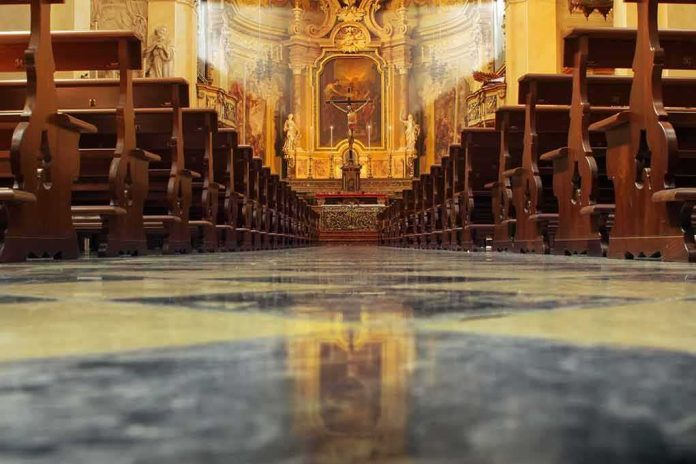
Gunmen opened fire on mourners inside a Greek Orthodox church in Jordan, killing seven and wounding dozens during a funeral, in what officials called a terrorist attack by extremists.
Story Snapshot
- Officials reported seven dead and about 40 wounded after gunmen attacked a funeral at a Greek Orthodox church.
- Jordan’s interior minister labeled the assault a terrorist act by extremists; no group claimed responsibility.
- Witness accounts and security footage suggested multiple attackers and a planned assault.
- Authorities had not identified the attackers or confirmed links to any organization.
What Authorities Confirmed About the Church Attack
Jordanian officials said the shooting happened on October 23 during a funeral at a Greek Orthodox church in Karak governorate. The Public Security Directorate reported seven people killed and dozens wounded. Interior Minister Mazin Al-Farrayeh called it a terrorist act by extremists. Reuters cited officials putting the wounded at about 40 people. The figures varied in early reports, which is common in breaking events. Police launched a manhunt after the attackers fled the scene.
Officials did not release names of suspects or confirm an organization. The interior minister said it was too early to say whether the attackers had ties to any known group inside or outside Jordan. No group had claimed responsibility as of the initial coverage. These facts leave motive and affiliation open, even as the government framed the assault as extremist violence targeting a church funeral.
How the Attack Unfolded, According to Witnesses
Witness and survivor accounts described masked gunmen and a sudden burst of gunfire inside or near the church compound. Reporting referenced security-camera footage that appeared to show multiple attackers, with one carrying a rifle consistent with an assault weapon. Some outlets mentioned an explosion before the shooting, while others focused on gunfire alone. The number of attackers varied across reports, ranging from two to three, pointing to a coordinated assault rather than a stray shooter.
The setting amplified the shock. The attack struck mourners during a religious rite at a Christian place of worship. That timing and location fit patterns seen in sectarian or extremist violence in the region, according to officials and analysts. Still, without named suspects or a public claim, the exact motive remained unclear. Investigators faced the task of matching casings, weapons, vehicles, and escape routes to build a clear timeline and identify the network behind the hit.
Why This Matters Beyond Jordan
Attacks on houses of worship raise alarms far outside a single town. They test public trust in security services and government transparency. People on the left and the right know that after major attacks, early labels harden fast, while hard facts arrive slowly. Clear updates on suspect identities, forensic evidence, and any group ties would help prevent confusion and rumors. Consistent casualty numbers and a verified timeline would also build confidence in the investigation.
A survivor and an injured woman recount the terrifying moments of the attack on Hammoud Church in Jordan’s Karak governorate.
Speaking to Roya, they describe the incident, which took place as they attended a funeral, as an unimaginable nightmare. pic.twitter.com/UDjqZ07sk3
— Roya News English (@RoyaNewsEnglish) October 24, 2026
For Americans watching, the lesson is familiar. When institutions keep key evidence sealed for long periods, frustration grows. In Jordan, publishing verified footage, ballistic results, and non-sensitive witness statements could ease doubts. In the United States, voters often feel leaders hide failures and dodge accountability. Here, the basic facts are solid: seven dead, many wounded, a church funeral targeted. The open questions demand proof-based answers, not spin, from those in power.
Sources:
thegatewaypundit.com, reuters.com, apnews.com, vaticannews.va, aljazeera.com, bbc.com