

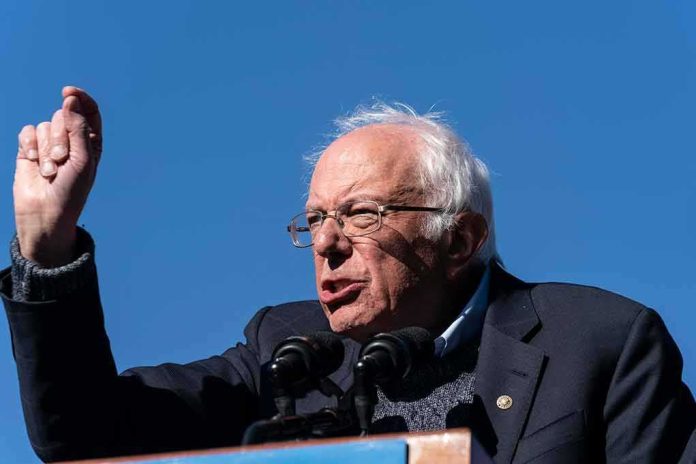
When a sitting senator says his own party is “way, way out of touch” and a “threat to democracy,” it signals just how deep America’s crisis of political trust has become.
Story Snapshot
- Bernie Sanders says Democratic leaders are funded by wealthy donors and ignore working-class Americans.
- He argues the party is a “threat to democracy” because insiders rig primaries and protect the status quo.
- His attacks highlight a wider anger at both parties’ establishment wings and at “billionaires buying elections.”
- The feud inside the left mirrors broader frustration on the right and left with a government seen as serving elites.
Sanders blasts Democrats as donor-driven and out of touch
Senator Bernie Sanders, an independent from Vermont who caucuses with Democrats, has sharply escalated his long fight with the Democratic Party’s leadership. In recent interviews, he says party leaders are “way out of touch” with ordinary Americans and dominated by “folks who have money and consultants.” He argues that Democratic leaders defend a status quo that leaves millions struggling with low wages, high costs, and a “rigged economy,” while campaign money from billionaires shapes who gets heard and who wins.
Sanders ties this criticism directly to working-class frustration. After a recent election setback, he wrote that a Democratic Party “which has abandoned working class people would find that the working class has abandoned them,” warning that leaders seem more focused on donors than on everyday families trying to pay rent and buy groceries. In Michigan and other key states, he backs challengers he calls true champions of workers and says it is “high time” for Democrats to stop “catering to wealthy campaign donors.”
From “abandoned the working class” to “threat to democracy”
Sanders does not just say Democrats are mistaken; he says the way party insiders run elections is dangerous. On a popular comedy podcast, he agreed with the idea that the Democratic Party has become a “threat to democracy.” He claims party leaders “rig” primaries, close off open competition, and rely on rules and superdelegates that give insiders more power than regular voters. This, he argues, keeps genuine working-class candidates off the ballot and protects leaders who are comfortable with growing inequality and concentrated wealth.
He links this process to big money and a professional political class. In that podcast, Sanders said there is now a “Democratic establishment…funded by wealthy people” and “consultants who are really way out of touch with reality” and “make a whole lot of money in campaigns” while “the working class is ignored.” In a separate statement, he warned about “billionaires…buying elections” through a campaign finance system that he calls corrupt and tilted toward corporate interests. For many Americans who already feel the system is rigged, these claims echo their lived experience.
A long-running feud inside the Democratic Party
This clash is not new. Sanders has criticized Democratic elites for decades, arguing that, starting in the 1970s, party leaders shifted from being the party of workers to aligning with corporations and the wealthy. He has accused the national committee of favoring establishment candidates, pushed to weaken the power of superdelegates, and backed primary challengers against sitting leaders when he felt the base was being ignored. Researchers who studied the 2016 convention found that Sanders supporters were far more skeptical of the party establishment than backers of Hillary Clinton.
Those tensions have flared again in recent primaries. In Michigan, a key Senate race has turned into a proxy fight between the Sanders wing and House Democratic leader Hakeem Jeffries, with Sanders arguing his endorsed candidates “represent working people” against a party that, in his view, bends too often to rich donors. At the same time, figures like former Chicago mayor Rahm Emanuel push back, warning that Sanders-style candidates could hurt Democrats in swing areas. Sanders counters that “people are sick and tired of the Rahm Emanuels and the Democratic establishment and the Republican establishment,” casting the struggle as elites versus the public.
Why this matters beyond Democrats vs. Democrats
Sanders’s words land in a country where many on both the left and the right already feel abandoned. Conservatives frustrated with past “woke” agendas, globalism, rising debt, and high energy costs see proof that Democratic leaders care more about ideological projects and donors than about truck drivers, nurses, and small business owners. Liberals angry about “America First” policies, cuts to social programs, and harsh immigration enforcement hear Sanders saying their own party has traded working-class voters for corporate checks and polished talking points.
Fetterman Torches Bernie in Blunt Attack — Sit Down
𝐅𝐄𝐓𝐓𝐄𝐑𝐌𝐀𝐍 𝐁𝐋𝐀𝐒𝐓𝐒 𝐁𝐄𝐑𝐍𝐈𝐄 𝐒𝐀𝐍𝐃𝐄𝐑𝐒 𝐅𝐎𝐑 𝐒𝐓𝐀𝐍𝐃𝐈𝐍𝐆 𝐁𝐘 𝐀𝐍 𝐀𝐂𝐂𝐔𝐒𝐄𝐃 𝐑∗𝐏𝐈𝐒𝐓 𝐖𝐈𝐓𝐇 𝐀 𝐍𝐀𝐙𝐈 𝐓𝐀𝐓𝐓𝐎𝐎 Sen. John Fetterman (D-Pa.) went after his own party’s progressive…
— JulietteSchwartz (@Juliett59778255) August 2, 2026
For both groups, the deeper worry is the same: a government run by an establishment that protects itself first. Sanders’s talk of “billionaires buying elections” and consultants “out of touch with reality” mirrors complaints about a broader “deep state” or elite class that spans parties. His charge that one of the country’s major parties is a “threat to democracy” because insiders rig the rules feeds a growing belief that ordinary citizens do not really choose their leaders anymore. Whether readers agree with Sanders or not, his attack shows how far faith in the system has fallen—and why many Americans now see both parties’ establishments, not just the other side, as part of the problem.
Sources:
mediaite.com, denvergazette.com, cnn.com, facebook.com, cnbc.com, monmouthcollege.edu, opendemocracy.net