

President Trump says he “would not mind” seeing Jensen Huang return as Nvidia’s chief executive, lending political weight to a corporate standoff that has already pulled in Elon Musk and more than 100,000 petition signers.
Story Snapshot
- President Trump said he would welcome Jensen Huang’s return as Nvidia CEO, days after Huang’s resignation.
- A “Stand with Jensen” petition gathered over 100,000 signatures, including thousands of Nvidia employees and shareholders, plus Elon Musk’s support.
- Nvidia’s board said it is investigating reports that Huang was targeted by a foreign intelligence effort, but has no evidence company secrets were compromised.
- The board named Chief Financial Officer Colette Kress as interim CEO and has not committed to bringing Huang back.
Trump Adds His Voice to the Debate
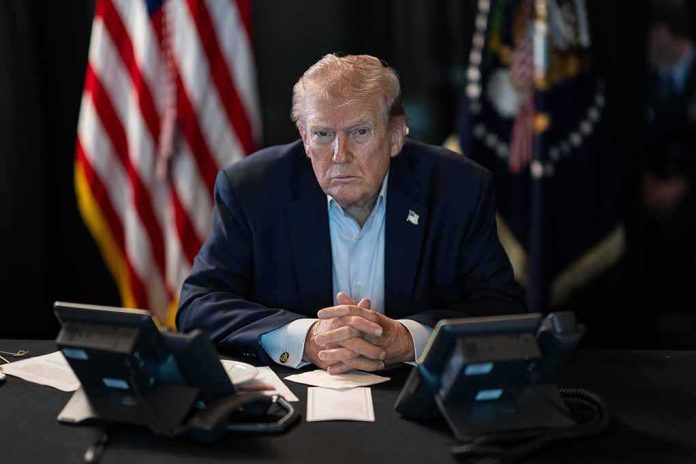
President Trump told reporters he would not object if Nvidia’s board decided to bring Jensen Huang back as chief executive. His comment came just days after Huang’s abrupt resignation and as a grassroots campaign for his return was already gaining steam across Silicon Valley and Wall Street. The president did not say he was pressuring the board, only that he would welcome the outcome.
Trump’s remark matters because it signals how far the Huang story has traveled beyond a corporate personnel matter. Nvidia is the most valuable chipmaker in the world and a linchpin of the artificial intelligence boom. A sitting president weighing in on who should run it shows how closely Washington now tracks decisions once left entirely to company boardrooms.
A Petition Built on Due Process, Not Innocence
The “Stand with Jensen” petition reportedly collected more than 115,000 signatures, including nearly 6,000 current Nvidia employees, over 1,100 former employees, and more than 63,000 self-identified shareholders. Elon Musk, Tim Sweeney, Garry Tan, and Amjad Masad are among the listed supporters. The petition does not claim Huang is innocent. Instead, it asks the board to reinstate him while an independent investigation finishes its work.
That distinction matters. Supporters are not asking Nvidia to drop its inquiry. They are arguing Huang should not lose his job before the facts are settled. Two major investors, Altimeter Capital’s Brad Gerstner and Atreides Management’s Gavin Baker, made a similar point in a letter urging the board to avoid “unnecessary haste” in replacing Huang before all the facts are known.
What Actually Triggered the Resignation
Nvidia’s board said days before Huang’s resignation that it was launching an independent investigation after reports that Huang had been the target of a foreign intelligence effort. The board said it had no reason to believe national security or company secrets were compromised, but that its inquiry would examine all available information. At that point, the board publicly stated it had confidence in Huang and his leadership team.
Huang then resigned as president, CEO, and board member, effective immediately, after separate reports surfaced concerning his personal relationships. Nvidia’s resignation announcement did not state a specific cause. News outlets including the BBC and CBS reported the departure centered on affair allegations and a woman some U.S. officials reportedly suspected of ties to Chinese intelligence, though the public record does not include a finished investigative report or sworn testimony confirming those suspicions.
Nvidia’s Board Signals Continuity, Not a Pending Comeback
Nvidia named Chief Financial Officer Colette Kress as interim CEO while she continues serving as CFO until a permanent successor is chosen. Kress said Nvidia’s strength “has always come from its people” and that she is committed to building on the foundation Huang created over 33 years, language that frames the company’s future around its workforce rather than one individual. Board chair Harvey Jones said the board has “full confidence” in Kress and expects operations, customer commitments, and the product roadmap to continue without interruption.
Days after resigning, Jensen Huang is reportedly eyeing a return as Nvidia CEO-backed by major investors, employees, and a 160K+ petition signed by Elon Musk.
With U.S. export cntrol probes and calls for an outside CEO swirling, his comeback isn't assured
Would you reinstate him? pic.twitter.com/cyo6uyBkIS— RaMaDan (@AHTechTalk) November 16, 2026
Nothing in the board’s public statements commits to reinstating Huang. The search for a permanent CEO explicitly considers internal and external candidates, not Huang’s automatic return. That leaves a real gap between what Trump, Musk, and petition signers want and what Nvidia’s directors have actually promised.
A Familiar Governance Puzzle
Corporate research on founder-led companies shows this kind of standoff is common when a company’s identity is tightly bound to its founder. Academic reviews of founder-CEO cases find no universal rule for whether a founder should stay or return after controversy; outcomes depend on the firm’s maturity, the strength of its board, and whether performance holds up without him. Nvidia’s case will test whether its value depends on Huang personally or on the products and workforce Kress now leads.
For many Americans already skeptical of both corporate boardrooms and government influence, the episode raises a familiar question: who really gets to decide, and on what evidence? A president weighing in, unverified petition totals, and a board investigation with no public findings leave plenty of room for distrust on both the left and right, regardless of how the Nvidia succession ultimately plays out.
Sources:
youtube.com, cnbc.com, techcrunch.com, bbc.com, news.sbs.co.kr